

Rituximab is used to treat glomerular diseases (GD); however, the ideal dose schedule has not been yet defined. The aim of this study is to analyze the influence of rituximab exposure on clinical outcomes in GD.
Materials and methodsThis is a single-center, open-label study including adults with GD treated with rituximab. Patients received 0.5–1g on day 1 (sometimes repeated on day 14), and blood and urine samples were collected up to day 45 to measure biochemical markers, rituximab levels. Area under the curve (AUC) was calculated by linear regression. Clinical outcomes were measured at month 6 and 12.
ResultsA total of 35 cases (30 patients) were finally included in the study. Baseline characteristics: 63.4 (17.6) years-old, 20 (57.1%) men. Diagnosis: 14 (40%) MN, 12 (34.3%) AAV, 9 (25.7%) INS. No infusion reactions occurred during the time of the study. Rituximab plasma concentration at day 28 (Cp28)>100μg/mL has the highest predictive capacity for complete response (CR) at month 6. There were more CR at month 6 in those cases with Cp28>100μg/mL compared to Cp28<100μg/mL (p=0.026), the same was observed when combining CR at 6 and 12 months (p=0.038).
ConclusionsCp28>100μg/mL is associated with a higher likelihood of CR at 6 months. Although greater drug exposure was linked to better response, no significant correlation was found with longer-term outcomes, highlighting the need for further studies to define the optimal dosing schedule.
El rituximab se utiliza para tratar las enfermedades glomerulares (EG); sin embargo, el esquema de dosis ideal aún no ha sido definido. El objetivo de este estudio es analizar la influencia de la exposición a rituximab en los resultados clínicos en las EG.
Materiales y métodosSe trata de un estudio unicéntrico, abierto, que incluye adultos con EG tratados con rituximab. Los pacientes recibieron 0,5 o 1 g el día 1 (en algunos casos una dosis adicional el día 14), y se recogieron muestras de sangre y orina hasta el día 45 para medir marcadores bioquímicos y concentración de rituximab. El área bajo la curva (AUC) se calculó mediante regresión lineal. Los resultados clínicos se evaluaron a los 6 y 12 meses.
ResultadosUn total de 35 casos (30 pacientes) fueron finalmente incluidos en el estudio. Características basales: 63,3 (17,6) años, 20 (57,1%) hombres. Diagnóstico: 14 (40%) MN, 12 (34,3%) VAA, 9 (25,7%) SNI. No se produjeron reacciones a la infusión durante el estudio. La concentración plasmática de rituximab en el día 28 (Cp28) >100 μg/ml presentó la mayor capacidad predictiva de respuesta completa a los 6 meses. Hubo más casos de respuestas completa a los 6 meses en aquellos casos con Cp28 >100 μg/ml en comparación con Cp28<100 μg/ml (p=0,026); se observó lo mismo al combinar la respuesta completa a los 6 y 12 meses (p=0,038).
ConclusionesCp28 > 100 μg/ml se asocia con una mayor probabilidad de respuesta completa a los 6 meses. Aunque una mayor exposición al fármaco se relacionó con una mejor respuesta, no se encontró una correlación significativa con los resultados a más largo plazo, lo que pone de manifiesto la necesidad de futuros estudios para definir el esquema de dosificación óptimo.
Rituximab is a chimeric monoclonal antibody targeting the CD20 protein expressed on B cells, leading to their depletion. Initially approved for the treatment of non-Hodgkin's lymphoma, its use has expanded to several autoimmune diseases, including glomerular diseases (GD) such as idiopathic nephrotic syndrome (INS)—which encompasses minimal change disease (MCD) and focal segmental glomerulosclerosis (FSGS)—as well as membranous nephropathy (MN) and antineutrophil cytoplasmic antibody (ANCA)-associated vasculitis (AAV).1,2
Rituximab dosages and frequencies in GD have been extrapolated from other indications; however, this population shows differential characteristics that could alter rituximab pharmacokinetics and compromise treatment exposure and efficacy.3 In this context, the aim of this study is to analyze the influence of rituximab exposure on clinical outcomes in GD.
MethodsStudy designThis was a single-center, open-label, uncontrolled clinical trial that included patients with glomerular diseases diagnosed by renal biopsy who required rituximab treatment. The study (NEFRTX, EudraCT: 2020-000484-23) was approved by the Spanish Agency of Medicines and Medical Products and the Vall d’Hebron Clinical Research Ethics Committee in July 2020. The patients were recruited between September 2020 and May 2023.
ParticipantsEligible subjects were adults affected by GD (INS, MN and AAV) who required treatment with rituximab according to international guidelines and nephrologist criteria, approved by the Pharmacy & Therapeutics Committee in our center. Informed consent was obtained from all the participants.
Exclusion criteria included having received rituximab in the last 6 months, an estimated life expectancy shorter than 6 months, potentially requiring hemodialysis in the following 3 months (glomerular filtration rate [GFR]≤20mL/min), being enrolled in another clinical trial and being unable to provide informed consent or commit to 1 year follow up in our center. Some patients were enrolled more than once because they received rituximab more than 6 months apart during the time of the study.
Patients were considered evaluable on a per protocol basis when at least three blood samples were collected for rituximab concentration determination during the 45 days after rituximab administration. Patients could be enrolled in case they received rituximab more than 6 months apart during the time of the study, which is considered sufficient for rituximab to be completely washed out.
ProceduresThe patients received rituximab according to clinical practice. One dose of rituximab (0.5g or 1g) was administered on day 1 and it could be administered again on day 14 based on the clinician's criteria. Determination of serological status for hepatitis and tuberculosis screening were conducted and oral prophylaxis with trimethoprim-sulfamethoxazole was prescribed prior to the initiation of rituximab.
Rituximab (Rixathon®) was prepared by the Hospital Pharmacy Service following the Summary of Drug Characteristics and Good Manufacturing Practice. The drug was administered in the day hospital by nurses according to the standard practice: 1g of paracetamol, 40mg of methylprednisolone and 5mg of dexchlorpheniramine were administered prior to rituximab infusion and the rate of rituximab infusion was individualized considering patients’ weight and prior exposure to the drug. Weight, blood pressure and the incidence of infusion reactions were recorded on the day of rituximab administration.
Blood and 24-h urine samples were collected on days 1 (pre and post rituximab administration), 7, 14 (pre and post rituximab administration), 28 and 45.
Data collectionBiochemical analysis performed in blood samples collected included: albumin, cholesterol, C reactive protein, plasma immunoglobulin G (pIgG), 24-h proteinuria, ANCA and anti-phospholipase A2 receptor (anti-PLA2R) antibodies.
Patient data, including weight, height, body surface area (BSA) and body mass index (BMI) were recorded, as well as other clinical characteristics, such as type of disease and concomitant immunosuppressive treatment, including tacrolimus, mycophenolate and corticosteroids.
Rituximab levels were measured using an Enzyme-Linked Immunosorbent Assay (ELISA) kit, Lisa-Tracker® Rituximab (Theradiag®), according to manufacturer's instructions in serum samples. When rituximab concentration was greater than 50ng/mL, the plasma was diluted 1:10. Rituximab area under the curve (AUC) was calculated by linear regression considering a one-compartment model. AUC and rituximab plasma concentration on day 28 and 45 were considered indicative parameters of exposure to rituximab.
Clinical outcomesClinical outcomes were evaluated at month 6 and 12 after rituximab administration by two independent Clinical Nephrologists. Cases were categorized as complete response (CR), partial response, relapse and no response, according to Kidney Disease: Improving Global Outcomes (KDIGO) guidelines. In case of disagreement, a third Clinical Nephrologist made the final decision. To analyze the effect of rituximab exposure on efficacy, CR at 6 and 12 months was considered, as opposed to the alternative (which includes partial response, no response, and relapse).
Statistical analysisContinuous variables were summarized as mean and standard deviation (SD), whereas categorical variables were expressed as absolute frequencies and percentages.
Comparisons between groups were performed using the Student's t-test for independent samples when variables followed a normal distribution. Categorical variables were compared using the Chi-square test or Fisher's exact test, as appropriate. Since one patient could be included in the study multiple times, a generalized linear mixed-effects model with a binomial distribution and logit link was fitted, including a random intercept for patient to account for within-subject correlation.
Logistic regression analysis was conducted to evaluate the association between prior exposure to rituximab and the outcomes of interest. Results were reported as odds ratios (ORs) with 95% confidence intervals (95% CI). When appropriate, multivariable models were constructed to adjust for clinically relevant covariates and potential confounders selected based on clinical relevance and univariate analysis.
Statistical analysis was performed using the Statistical Package for the Social Sciences (SPSS) version 26.0 (IBM Corp., Armonk, NY, USA). For single-outcome comparisons, the observed effect was considered significant if p values were ≤0.05.
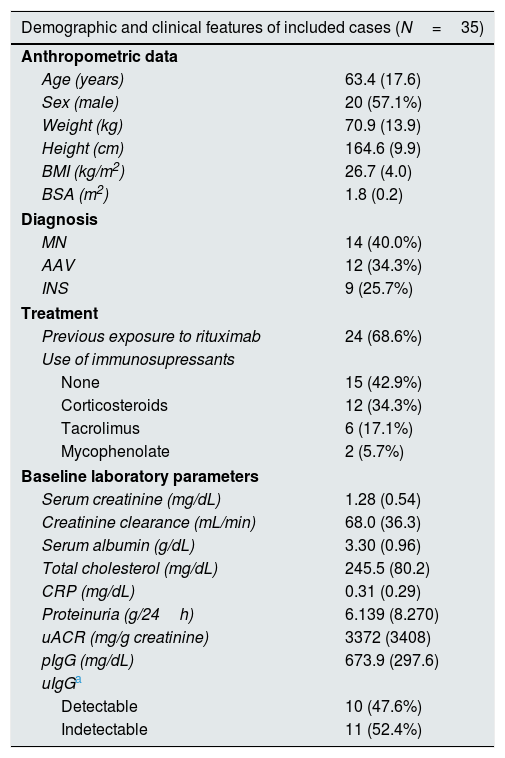
ResultsA total of 35 cases (30 patients) were finally included in the analysis (Supplementary Fig. 1). The baseline characteristics of the cohort have been previously reported5; for completeness, they are provided again in Table 1. The cohort mainly consisted of older adults, predominantly male, with overweight and moderately impaired kidney function at baseline. MN was the most common diagnosis, followed by AAV and INS. A high proportion of patients had prior exposure to rituximab and were receiving immunosuppressive therapy, together with marked baseline proteinuria.
Baseline characteristics of the study cohort.
| Demographic and clinical features of included cases (N=35) | |
|---|---|
| Anthropometric data | |
| Age (years) | 63.4 (17.6) |
| Sex (male) | 20 (57.1%) |
| Weight (kg) | 70.9 (13.9) |
| Height (cm) | 164.6 (9.9) |
| BMI (kg/m2) | 26.7 (4.0) |
| BSA (m2) | 1.8 (0.2) |
| Diagnosis | |
| MN | 14 (40.0%) |
| AAV | 12 (34.3%) |
| INS | 9 (25.7%) |
| Treatment | |
| Previous exposure to rituximab | 24 (68.6%) |
| Use of immunosupressants | |
| None | 15 (42.9%) |
| Corticosteroids | 12 (34.3%) |
| Tacrolimus | 6 (17.1%) |
| Mycophenolate | 2 (5.7%) |
| Baseline laboratory parameters | |
| Serum creatinine (mg/dL) | 1.28 (0.54) |
| Creatinine clearance (mL/min) | 68.0 (36.3) |
| Serum albumin (g/dL) | 3.30 (0.96) |
| Total cholesterol (mg/dL) | 245.5 (80.2) |
| CRP (mg/dL) | 0.31 (0.29) |
| Proteinuria (g/24h) | 6.139 (8.270) |
| uACR (mg/g creatinine) | 3372 (3408) |
| pIgG (mg/dL) | 673.9 (297.6) |
| uIgGa | |
| Detectable | 10 (47.6%) |
| Indetectable | 11 (52.4%) |
Values are presented as n (%) or mean (standard deviation), as appropriate. BSA: body surface area, BMI: body mass index, MN: membranous nephropathy, AAV: ANCA-associated vasculitis, INS: idiopathic nephrotic syndrome, CRP: C-reactive protein, uACR (urine albumin-creatinine ratio), pIgG: plasma immunoglobulin G, uIgG: urine immunoglobulin G.
Six months after rituximab administration, 9 (25.7%) cases achieved CR, 19 (54.3%) cases reached partial response, and no response was detected in 7 (20.0%). At month 12, 33 cases were assessed; two cases were lost to follow-up, one due to death unrelated to rituximab treatment and the other due to transfer to another community. Of the 33 cases evaluated at month 12, 10 (30.3%) showed CR, 15 (45.5%) partial response, 4 (12.1%) showed no response to treatment, and 4 (12.1%) cases of relapse were detected. The results were analyzed by pathology, showing a similar response rate across all pathologies, with slightly less efficacy observed in AAV. The outcome of the generalized linear mixed model with binomial distribution and logit link fitted, including a random intercept for patient to account for within-subject correlation, was comparable – coefficient, −4387, p=0.003–, demonstrating no influence of prior exposure to rituximab and repeated inclusion in the study. No infusion reactions or serious adverse events occurred during the time of the study.
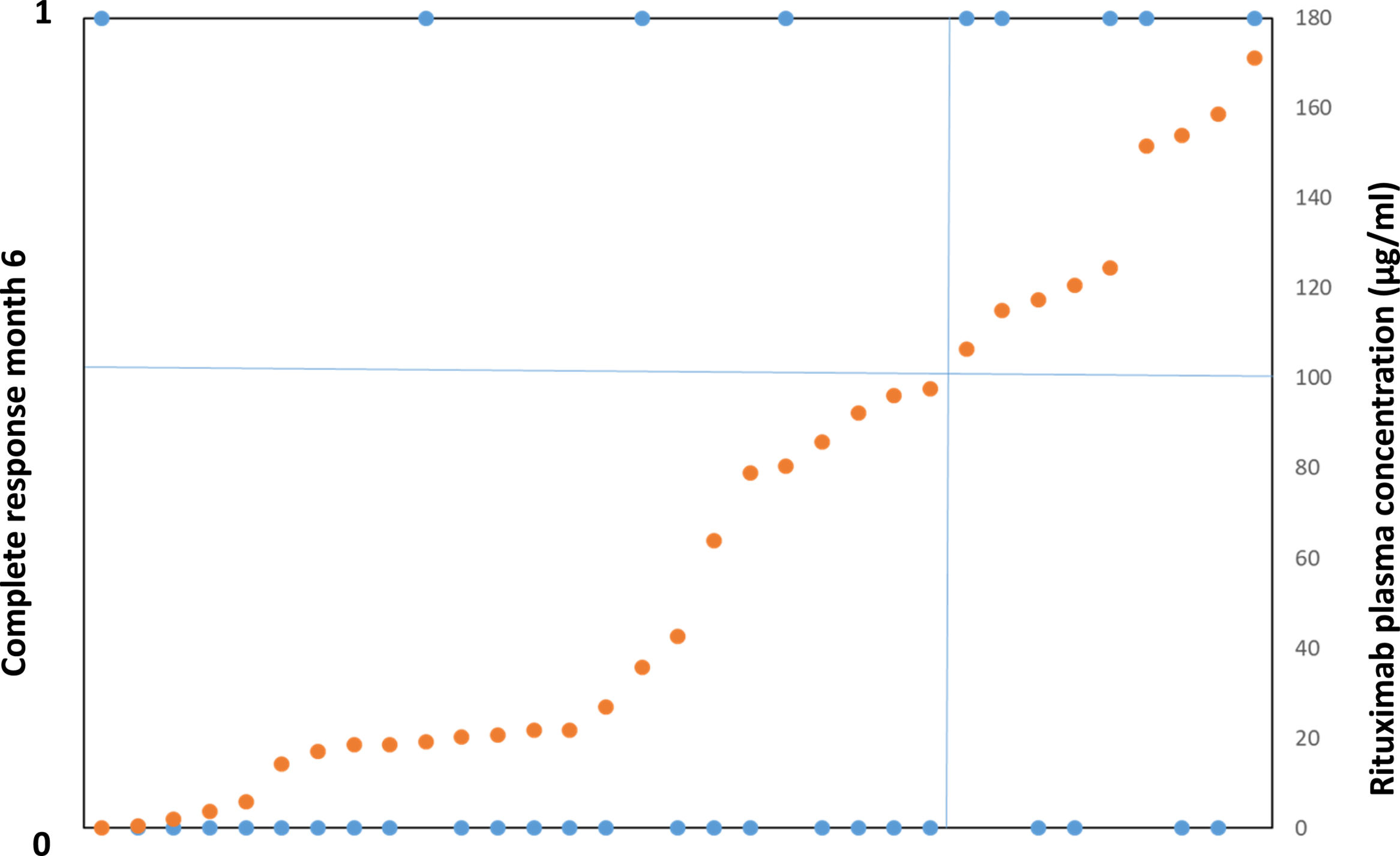
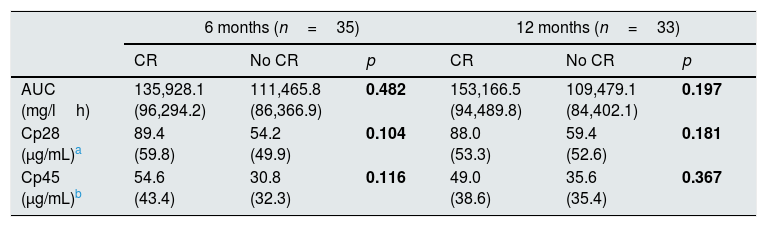
Rituximab exposure, measured as AUC, concentration in plasma at day 28 (Cp28) and concentration in plasma at day 45 (Cp45) was consistently higher, after 6 and 12 months, in the CR group compared to no-CR (Table 2); however, differences were not statistically significant. When the relationship between Cp28 and CR-6m was further analyzed, Cp28>100μg/mL showed the highest predictive capacity for CR-6m, with a sensitivity of 55.6% (95% confidence interval [CI]: 23.1–88.0), a specificity of 84.6% (95% CI: 70.7–98.5), a positive likelihood ratio of 3.6 (95% CI: 1.2–10.6), and a negative likelihood ratio of 0.5 (95% CI: 0.2–1.1) (Fig. 1, Supplementary Table 1). The Cp28>100μg/mL threshold represented the optimal cutoff according to the Youden index. The Youden index value (J=0.402) indicated a moderate discriminative ability. Internal validation using bootstrap resampling with 1000 iterations yielded B=1.928 (p=0.010), suggesting that the observed effect was consistent. However, the 95% confidence interval ranged from −0.203 to 22.732 and was sufficiently wide to preclude drawing definitive conclusions from these findings.
Impact of rituximab exposure on clinical response at 6 and 12 months.
| 6 months (n=35) | 12 months (n=33) | |||||
|---|---|---|---|---|---|---|
| CR | No CR | p | CR | No CR | p | |
| AUC (mg/lh) | 135,928.1 (96,294.2) | 111,465.8 (86,366.9) | 0.482 | 153,166.5 (94,489.8) | 109,479.1 (84,402.1) | 0.197 |
| Cp28 (μg/mL)a | 89.4 (59.8) | 54.2 (49.9) | 0.104 | 88.0 (53.3) | 59.4 (52.6) | 0.181 |
| Cp45 (μg/mL)b | 54.6 (43.4) | 30.8 (32.3) | 0.116 | 49.0 (38.6) | 35.6 (35.4) | 0.367 |
Data is expressed as mean (standard deviation).

Impact of rituximab plasma concentration on day 28 (Cp28) on the 6-month response. n=33. Cases are shown in orange, ordered from lowest to highest Cp28. The axes indicate the cutoff point of Cp=100μg/mL. The upper horizontal bars represent cases with complete remission at 6 months (n=9), and the inner bars represent cases without remission at 6 months (n=24). The calculated area under the curve-ROC is 0.701 and the 95% confidence interval is 0.485–0.917.
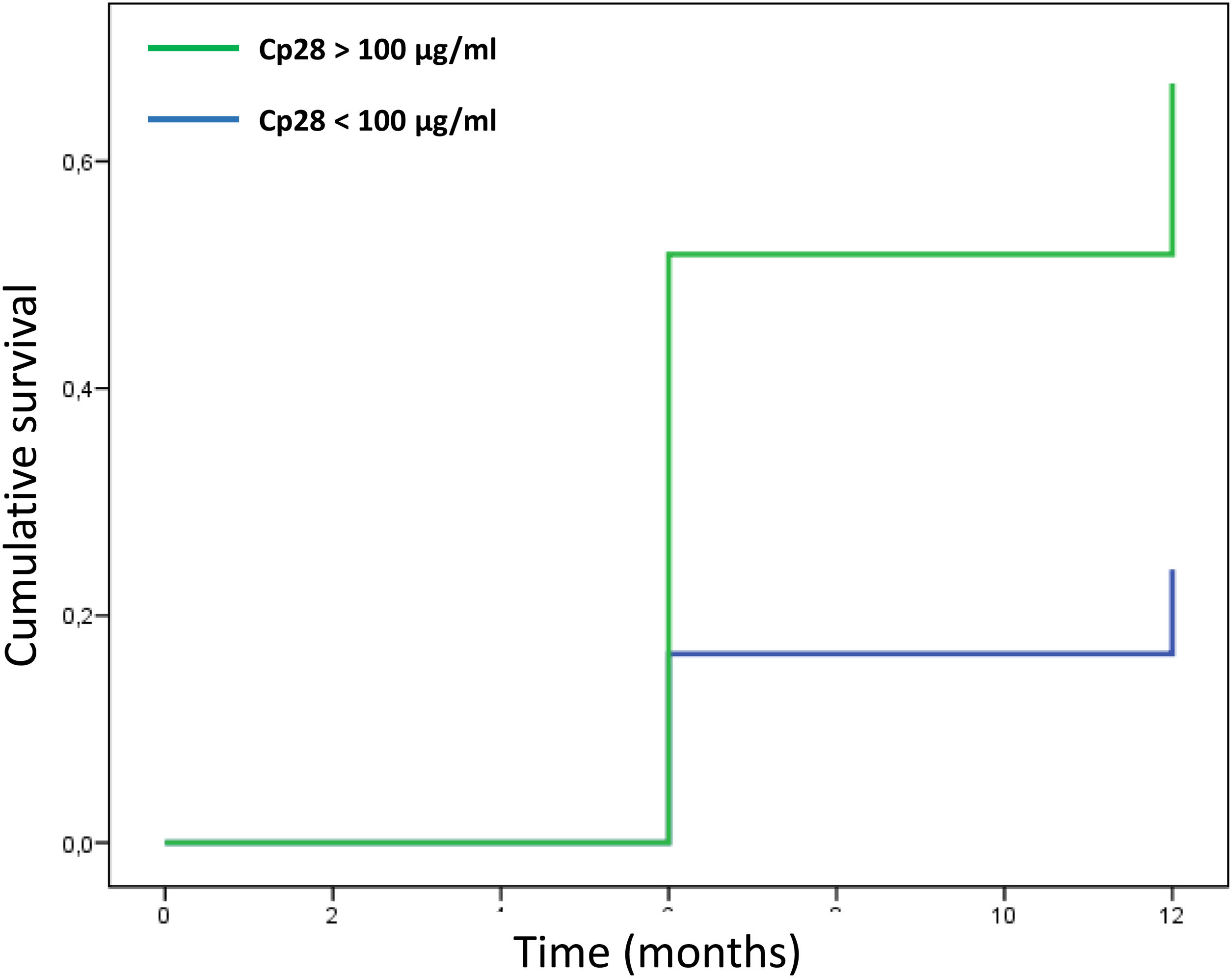
Cp28 was >100μg/mL in 9 cases, of whom 5 (55.6%) achieved CR-6m, and Cp28 was <100μg/mL in 26 cases, of whom only 4 (15.4%) achieved CR-6m. Fig. 2 shows the survival curves for cases achieving CR-6m and CR-12m for the Cp28>100μg/mL group compared with the Cp28<100μg/mL group. A significantly higher proportion of CR-6m was observed in cases with Cp28>100μg/mL vs. Cp28 < 100μg/mL (p=0.026). This difference was maintained at 12 months, but did not reach statistical significance (p=0.063); however, when CR at 6 and 12 months was combined, a significantly higher response was observed in cases with Cp28>100μg/mL (p=0.038). Disease-specific efficacy and rituximab exposure data is shown in Supplementary Table 2.

The influence of demographic factors (sex and age), analytical parameters (serum albumin and proteinuria) and use of immunosuppression were studied; none of them showed significant association or modified the observed association between rituximab exposure (Cp28>100μg/mL) and CR-6m. Only serum albumin showed an independent significant association with CR-12m (p=0.013), which did not affect the main effect nor showed collinearity with Cp28>100μg/mL.
DiscussionThe present study shows that rituximab exposure is related to a better outcome in patients with GD; specifically, cases with Cp28>100μg/mL exhibit significantly better clinical outcomes compared with those with lower concentrations, suggesting that early drug exposure may be a key determinant of therapeutic response.
Previous studies indicate that there is a certain rituximab concentration required to achieve a complete B cell depletion across different clinical entities due to rituximab pharmacodinamics.4 Our results align with emerging evidence that adequate rituximab exposure is critical for efficacy in patients affected by GD, where altered pharmacokinetics (including increased clearance and reduced half-life), have been reported due to factors such as proteinuria and disease-specific characteristics, potentially leading to suboptimal drug levels and treatment failure.3,5,6
Specifically, Teisseyre et al. concluded that undetectable rituximab in plasma at 3 months after drug administration was a predictor of treatment failure in patients with MN and INS.7 Also, Destere et al. used Machine learning to identify risk factors for rituximab underexposure and suggested an intensive monitoring of those patients with MN at risk in order to readily provide additional rituximab doses in cases with poor evolution.6 Interestingly, Liang et al. developed a pharmacokinetic model of rituximab in GD and suggested dose individualization in order to optimize exposure and reduce costs.8 Finally, Hartinger et al. explored rituximab pharmacokinetics in patients with GD and lupus, concluding that dose intensification might be beneficial in certain cases.9 Regarding AAV, Pasquiers et al. suggested that 1000mg every 4 months might be preferred over less intense alternative dosages.10 Together, all these recent studies point out that current rituximab schedules might lead to insufficient drug exposure in GD, which could jeopardize treatment efficacy; however, even if some of them suggested alternative doses and frequency they have not proved its efficacy in the clinical setting; therefore, the optimal schedule remains to be established, warranting further investigation.
This study has certain limitations. First, this was a low-intervention clinical study carried out in the real world setting, therefore, our priority was to reduce the burden on patients by collecting the fewest number of samples, which has limited our ability to identify the optimal time to measure Cp in order to predict response. Second, patients with a baseline GFR≤20mL/min were excluded from the clinical trial; therefore, the findings may not be generalizable to more complex clinical situations. Moreover, due to the small number of patients and the diversity of diagnoses, the power of the study is modest; for instance, a larger patient cohort might have allowed the detection of statistically significant associations between AUC, Cp28 and Cp45 and CR-6m and CR-12m. Given the limited sample size, the findings of this study should be interpreted with caution. Further research is needed to confirm and extend these results.
ConclusionsCp28>100μg/mL predicts a higher likelihood of CR-m6 in patients with GD treated with rituximab. Rituximab exposure was consistently higher in case of CR; however, no significant correlation was observed between AUC, Cp28 or Cp45 and CR-6m or CR-12m. Further studies are needed to confirm the target rituximab exposure and define the optimal dose schedule in order to ensure adequate treatment management in GD.
FundingThis work has been funded by the Catalan Society of Clinical Pharmacy with 12.000€.
Conflicts of interestThe authors declare no conflicts of interest.
The authors thank the patients who participated in this study, Vall d’Hebron Nephrology and Immunology Services for their collaboration, and the Catalonian Society of Clinical Pharmacy for their financial support.
The followings are the supplementary data to this article: