



We read with great interest the retrospective study by Asensi-Díaz et al.1 characterizing drug-induced hyponatraemia (DIH) in 159 patients admitted to Internal Medicine over one year, representing 3.1% of ward admissions. Given the frequency, severity, and preventable nature of this condition, the authors’ effort to profile the implicated drug classes and clinical course is a welcome contribution to a literature still dominated by spontaneous-reporting pharmacovigilance data rather than ward-level cohorts. We would like to raise two points that we believe bear directly on how the reported drug ranking and volume-status findings should be interpreted and generalized.
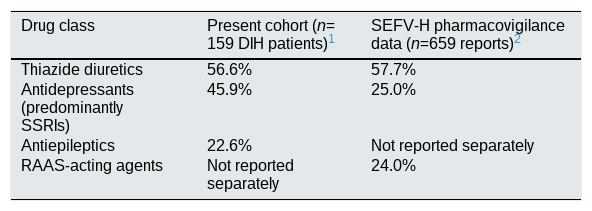
First, regarding causality attribution. The authors report antidepressants — predominantly selective serotonin reuptake inhibitors (SSRIs) — as implicated in 45.9% of DIH episodes, nearly double the 25.0% recently reported in a nationwide analysis of 659 cases from the Spanish Pharmacovigilance System (Sistema Español de Farmacovigilancia de medicamentos de Uso Humano, SEFV-H, Table 1), while the thiazide-diuretic proportion is closely concordant between the two sources (56.6% vs 57.7%).2 Given the cohort's advanced median age (87 years) and stated multimorbidity — a population in which thiazides for hypertension and SSRIs for late-life depression or anxiety are frequently co-prescribed — and the authors’ own observation that patients exposed to ≥2 implicated drugs experienced more severe hyponatraemia, we wonder whether a structured causality algorithm (e.g., Naranjo or World Health Organization–Uppsala Monitoring Centre [WHO-UMC] system) was applied whenever more than one plausible culprit drug was present.3 Without such a framework, the relative ranking of drug classes may partly reflect prescribing patterns or diagnostic ascertainment bias rather than true differential nephrogenic risk — a distinction with direct bedside implications for which drug a clinician should suspect and withdraw first.
Implicated drug classes: present cohort vs. national pharmacovigilance data.
| Drug class | Present cohort (n=159 DIH patients)1 | SEFV-H pharmacovigilance data (n=659 reports)2 |
|---|---|---|
| Thiazide diuretics | 56.6% | 57.7% |
| Antidepressants (predominantly SSRIs) | 45.9% | 25.0% |
| Antiepileptics | 22.6% | Not reported separately |
| RAAS-acting agents | Not reported separately | 24.0% |
DIH: drug-induced hyponatraemia; SEFV-H: Sistema Español de Farmacovigilancia de medicamentos de Uso Humano; SSRIs: selective serotonin reuptake inhibitors; RAAS: renin–angiotensin–aldosterone system.
Second, regarding volume-status classification. The authors report 69.8% of patients as euvolaemic. Per this journal's own clinical practice guideline on hyponatraemia, correct aetiological classification should rest on paired plasma/urine osmolality and urine sodium rather than clinical examination alone, since bedside volume assessment has documented poor inter-observer reliability, particularly in older, multimorbid patients.4,5 Thiazides classically produce a mixed or hypovolaemic phenotype, whereas SSRIs and antiepileptics act principally through the syndrome of inappropriate antidiuretic hormone secretion (SIADH); whether the reported euvolaemic proportion held consistently across drug classes, and whether it was defined biochemically or clinically, would materially affect interpretation of the 23.9% of patients that received no specific treatment, since this decision hinges precisely on that distinction.6
These questions do not detract from the clinical value of the series, which despite its retrospective, single-centre design offers a real-world counterpoint to spontaneous pharmacovigilance reporting and reinforces messages that remain underappreciated at the bedside: DIH is common, is frequently the primary reason for admission, and carries substantial readmission risk. Reporting the causality methodology and the biochemical basis of volume-status classification, even briefly, would strengthen the external validity of the drug ranking presented and could inform the design of future prospective, multicentre studies incorporating standardized causality scoring and paired osmolality panels.
We congratulate the authors on a timely contribution to an under-recognized cause of preventable hospital morbidity.
ORCID IDHefziba Lorences Noguera: 0009-0005-6570-007X.
Author contributionsBoth authors contributed to the conception, drafting, critical revision, and final approval of the manuscript.
Declaration of generative AI and AI-assisted technologies in the writing processDuring the preparation of this work, the author(s) used Claude (Anthropic) for literature search assistance and manuscript drafting support. After using this tool, the author(s) reviewed and edited the content as needed and take full responsibility for the content of this publication.
FundingThis research did not receive any specific grant from funding agencies in the public, commercial, or not-for-profit sectors.
Conflicts of interestEsteban Cardenas Duran: none. Hefziba Lorences Noguera: none.
None.