
Since the emergence of HIV, the epidemic has claimed approximately 40 million lives, with a particularly heavy impact on the LGTBQ+ community. Although a definitive cure remains elusive despite ongoing research into vaccines and technologies like CRISPR, two major interventions have transformed the clinical landscape: pre-exposure prophylaxis and highly active antiretroviral therapy (HAART). These have reduced infection rates while introducing new clinical considerations.1–3
Globally, the LGTBQ+ community faces a higher prevalence of chronic kidney disease, greater socio-health barriers, and elevated risk factors for nephrotoxicity.4 In fact, the LGTBQ+ community faces approximately a 1-year shorter life expectancy from age 20 compared to heterosexuals, according to the recent UK Office for National Statistics census. This underscores the profound health disparities and socio-health barriers affecting this population.4,5 This editorial focuses primarily on this community, as it bears a disproportionately high burden of understudied combinations of potential nephrotoxic agents. It is widely acknowledged that the majority of research on HIV prevention, pre-exposure prophylaxis (PrEP), recreational drugs and chemsex has predominantly focused on cisgender men who have sex with men (MSM) and transgender women. While this population bears a disproportionate burden of HIV infection, this focus has resulted in significant underrepresentation of other sexual and gender minorities within the LGTBQ+ community. Women who have sex with women, bisexual women, and lesbian individuals have been described as “invisible and understudied” in HIV research and other studies, despite facing unique vulnerabilities and risk profiles.
This editorial aims to inform about emerging renal risks in an inclusive and respectful manner, without promoting discrimination against any individual or group. It further promotes informed decision-making and supports the development of robust, preventive health policies. To this end, we conducted a literature review supplemented by artificial intelligence-based analytical tools to model and help predict future kidney outcomes.
Pre-exposure prophylaxis (PrEP)PrEP is a preventive strategy against HIV infection using combinations such as tenofovir disoproxil fumarate/emtricitabine (TDF), tenofovir alafenamide/emtricitabine (TAF), cabotegravir, and lenacapavir. In Spain, however, only TDF is widely used and publicly funded for high-risk individuals. Cabotegravir was recently introduced in the public system but restricted to selected cases. According to the ECDC 2025 report, there were 34,247 PrEP users in Spain and 344,596 across Europe, 90% of whom were MSM.6
Although PrEP introduction has been highly beneficial and cost-effective for the population, the nephrology community should be aware of its low but potentially cumulative nephrotoxic effects. Unlike TAF, TDF can damage the proximal convoluted tubule through an acquired mitochondriopathy, affecting around 12–15% of users.3 This damage results from intracellular TDF accumulation due to deficits in MRP-2 and MRP-4 transporters, which normally excrete it into the tubular lumen, similar to how other drugs are handled. The accumulation inhibits mitochondrial Complex V in proximal tubule cells, causing ATP depletion (reduced cellular energy), increased reactive oxygen species, and antioxidant depletion. If persistent and intensified, these effects lead to cell death.3,7 Clinically, this manifests as declining estimated glomerular filtration rate (eGFR) and/or subclinical non-selective proteinuria (tubular-origin proteins like beta-2 microglobulin). In severe cases, Fanconi syndrome can occur as a rare complication.8 Nevertheless, most renal events in TDF users are mild, transient, and reversible, with the greatest risk in those over 40–50 years old or with preexisting kidney disease.9 While a slight eGFR decline may occur at treatment initiation, mid-term safety of TDF and TAF remains uncompromised according to meta-analyses.1 Long-term kidney implications remain unclear, as most studies have lasted only up to 5 years, whereas TDF PrEP rollout began in Europe in 2016 and in Spain in 2019. Moreover, when combined with other nephrotoxic noxae, this damage can potentially progress to chronic kidney disease.3 Notably, switching from TDF to TAF improves renal function, highlighting the need for public funding of TAF to ensure better renal outcomes and ethical equity.3,8,10 However, TAF has a distinct safety profile, with metabolic effects that should be carefully considered on an individual basis.1,3
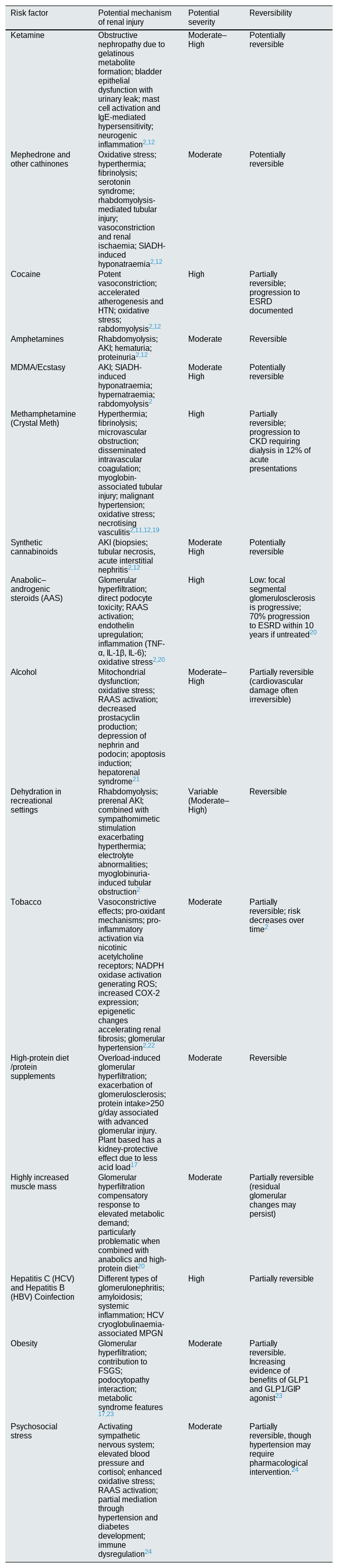
Risk factors for nephropathyIt has been published that the prevalence of potential non-classical nephrotoxic factors is increasing (Table 1). However, establishing their exact prevalence is challenging due to inconclusive data and underreporting due to social stigma and legal implications. Surveys and publications indicate a higher prevalence in the LGTBQ+ community, with differences among subgroups. There is a changing and increasing use of these drugs in sexualised contexts, a practise known as chemsex,11 particularly among MSM according to a 2024 cross-sectional study conducted in Europe with 14,652 participants.12,13 The use of mephedrone and other cathinones is rising, with unclear renal consequences.2,13 Chemsex transcends mere behavioural practice, serving as a barometer for the responsiveness of public health policies to the authentic diversity of populations, according to experts in the field.13 Several limitations hinder accurate estimation of the true renal risk burden from recreational drug use, including underreporting in LGTBQ+ populations; unquantified polydrug use; emerging novel psychoactive substances; unquantified adulterants; and long-term renal recovery.2,11,13
A list of some non-classical nephrotoxic risk factors of increasing prevalence.
| Risk factor | Potential mechanism of renal injury | Potential severity | Reversibility |
|---|---|---|---|
| Ketamine | Obstructive nephropathy due to gelatinous metabolite formation; bladder epithelial dysfunction with urinary leak; mast cell activation and IgE-mediated hypersensitivity; neurogenic inflammation2,12 | Moderate–High | Potentially reversible |
| Mephedrone and other cathinones | Oxidative stress; hyperthermia; fibrinolysis; serotonin syndrome; rhabdomyolysis-mediated tubular injury; vasoconstriction and renal ischaemia; SIADH-induced hyponatraemia2,12 | Moderate | Potentially reversible |
| Cocaine | Potent vasoconstriction; accelerated atherogenesis and HTN; oxidative stress; rabdomyolysis2,12 | High | Partially reversible; progression to ESRD documented |
| Amphetamines | Rhabdomyolysis; AKI; hematuria; proteinuria2,12 | Moderate | Reversible |
| MDMA/Ecstasy | AKI; SIADH-induced hyponatraemia; hypernatraemia; rabdomyolysis2 | Moderate High | Potentially reversible |
| Methamphetamine (Crystal Meth) | Hyperthermia; fibrinolysis; microvascular obstruction; disseminated intravascular coagulation; myoglobin-associated tubular injury; malignant hypertension; oxidative stress; necrotising vasculitis2,11,12,19 | High | Partially reversible; progression to CKD requiring dialysis in 12% of acute presentations |
| Synthetic cannabinoids | AKI (biopsies; tubular necrosis, acute interstitial nephritis2,12 | Moderate High | Potentially reversible |
| Anabolic–androgenic steroids (AAS) | Glomerular hyperfiltration; direct podocyte toxicity; RAAS activation; endothelin upregulation; inflammation (TNF-α, IL-1β, IL-6); oxidative stress2,20 | High | Low: focal segmental glomerulosclerosis is progressive; 70% progression to ESRD within 10 years if untreated20 |
| Alcohol | Mitochondrial dysfunction; oxidative stress; RAAS activation; decreased prostacyclin production; depression of nephrin and podocin; apoptosis induction; hepatorenal syndrome21 | Moderate–High | Partially reversible (cardiovascular damage often irreversible) |
| Dehydration in recreational settings | Rhabdomyolysis; prerenal AKI; combined with sympathomimetic stimulation exacerbating hyperthermia; electrolyte abnormalities; myoglobinuria-induced tubular obstruction2 | Variable (Moderate–High) | Reversible |
| Tobacco | Vasoconstrictive effects; pro-oxidant mechanisms; pro-inflammatory activation via nicotinic acetylcholine receptors; NADPH oxidase activation generating ROS; increased COX-2 expression; epigenetic changes accelerating renal fibrosis; glomerular hypertension2,22 | Moderate | Partially reversible; risk decreases over time2 |
| High-protein diet/protein supplements | Overload-induced glomerular hyperfiltration; exacerbation of glomerulosclerosis; protein intake>250g/day associated with advanced glomerular injury.Plant based has a kidney-protective effect due to less acid load17 | Moderate | Reversible |
| Highly increased muscle mass | Glomerular hyperfiltration compensatory response to elevated metabolic demand; particularly problematic when combined with anabolics and high-protein diet20 | Moderate | Partially reversible (residual glomerular changes may persist) |
| Hepatitis C (HCV) and Hepatitis B (HBV) Coinfection | Different types of glomerulonephritis; amyloidosis; systemic inflammation; HCV cryoglobulinaemia-associated MPGN | High | Partially reversible |
| Obesity | Glomerular hyperfiltration; contribution to FSGS; podocytopathy interaction; metabolic syndrome features17,23 | Moderate | Partially reversible. Increasing evidence of benefits of GLP1 and GLP1/GIP agonist23 |
| Psychosocial stress | Activating sympathetic nervous system; elevated blood pressure and cortisol; enhanced oxidative stress; RAAS activation; partial mediation through hypertension and diabetes development; immune dysregulation24 | Moderate | Partially reversible, though hypertension may require pharmacological intervention.24 |
AAS, anabolic-androgenic steroids; AKI, acute kidney injury; CKD, chronic kidney disease; COX-2, cyclooxygenase-2; ESRD, end-stage renal disease; FSGS, focal segmental glomerulosclerosis; GIP, glucose-dependent insulinotropic polypeptide; GLP-1, glucagon-like peptide-1; HBV, hepatitis B virus; HCV, hepatitis C virus; HTN, hypertension; IL-1β, interleukin-1 beta; IL-6, interleukin-6; MPGN, membranoproliferative glomerulonephritis; RAAS, renin-angiotensin-aldosterone system; ROS, reactive oxygen species; SIADH, syndrome of inappropriate antidiuretic hormone secretion; TNF-α, tumor necrosis factor-alpha.
In addition, risk factors like obesity, anabolic steroids, tobacco, stress, and high protein diet (whose prevalence may be higher in the LGTBQ+ community according to some studies with wide intra-community differences) waarant consideration, even if they may have minimal nephrotoxic effects. Some variables, like stress, are also difficult to measure. Indeed, stress itself may predispose individuals to misuse these substances as a coping mechanism to deal with the discomfort it causes.
Gender-affirming hormone therapy (GAHT) raises potential low-level kidney risks that require monitoring. Masculinising GAHT with testosterone significantly increases serum creatinine and cystatin C levels, while feminising GAHT with estradiol and anti-androgens elevates cystatin C-based eGFR and it is associated with an increased risk of nephrolithiasis, though its clinical relevance remains unclear. These alterations could be attributable to the modulatory effects of sex steroids on renal physiology and glomerular filtration markers, though their implications for actual kidney function remain undetermined. Existing evidence indicates that testosterone augments muscle mass and can elevate cystatin C concentrations, whereas estradiol and antiandrogens generally lower them. Although cystatin C is less dependent on muscle mass than creatinine, it is nevertheless responsive to hormonal and metabolic perturbations, thereby demanding judicious interpretation in the context of renal function monitoring during gender-affirming hormone therapy. Long-term nephrotoxic effects of GAHT require further prospective studies.14–16
Several situations commonly observed in the LGTBQ+ community can affect blood creatinine measurements: creatine supplementation or increased dietary intake, increased muscle mass, obesity or malnutrition associated with chronic inflammation in some HIV+ cases. Therefore, we strongly recommend estimating GFR using both cystatin C and creatinine to avoid misinterpretation.17 It is important to note that recent evidence shows creatine monohydrate supplementation is safe for the kidneys despite some infrequent reported cases of acute kidney injury (AKI).18
Regarding the quality of evidence, good-quality data exist for cocaine, smoking, and alcohol (multiple RCTs/prospective cohorts); moderate-quality evidence supports methamphetamine, ketamine, and HCV/HBV coinfection (case series, observational studies); whereas data remain limited for obesity, psychosocial stress alone, and protein supplements (case reports, mechanistic studies).
HIV-related kidney involvementSince the introduction of HAART, both mortality rates and the clinical profile of HIV+ patients have changed markedly, especially with the introduction of kidney-safe antiretroviral combinations. Classic HIV-associated nephropathy has decreased, while other forms of renal involvement (such as focal segmental glomerulosclerosis) and comorbidities like hypertension and diabetes have increased. These shifts have prompted a new histological classification of HIV nephropathies and updated recommendations for clinical management.3
Therapy for patients with CKD has significantly improved with the introduction of SGLT2i, GLP-1 RA, and dual GIP/GLP-1 RA such as tirzepatide, with growing evidence and ongoing clinical trials.17,23 Despite the poor evidence about these medications specifically in HIV patients with CKD, it is logical to assume optimal benefits for this population, especially considering their high cardiovascular risk profile.
Meanwhile, kidney transplantation practices have improved, including greater inclusion on waiting lists, acceptance of HIV+/APOL1-negative living donors, wider use of thymoglobulin with favourable outcomes, and new antiretrovirals with fewer drug interactions, among other advances beyond this editorial's scope.3
A simulation model to predict chronic kidney diseaseWhile evidence of varying quality documents the isolated renal damage attributable to each factor individually, no prospective studies have modelled multifactorial kidney insults in these contexts, despite the fact that renal impairment more commonly arises from multiple concurrent etiologies, as seen in other nephropathies. (e.g. mesoamerican nephropathy, AKI).25
The impact of some illegal drugs on general health and their societal consequences was elegantly reported by Nutt et al.26 However, these observations may not reflect the true extent of kidney compromise. Although many of these renal insults are reported as reversible, the cumulative effect of repeated and combined exposures remains unknown. Recently, a real-world German five-year observational cohort including 456 individuals on TDF showed that, although 14.3% of participants reported any use of higher-risk substances linked to chemsex, renal function trajectories were not analysed within this subpopulation, leaving the specific nephrotoxic interaction between PrEP and recreational drug use unaddressed.27
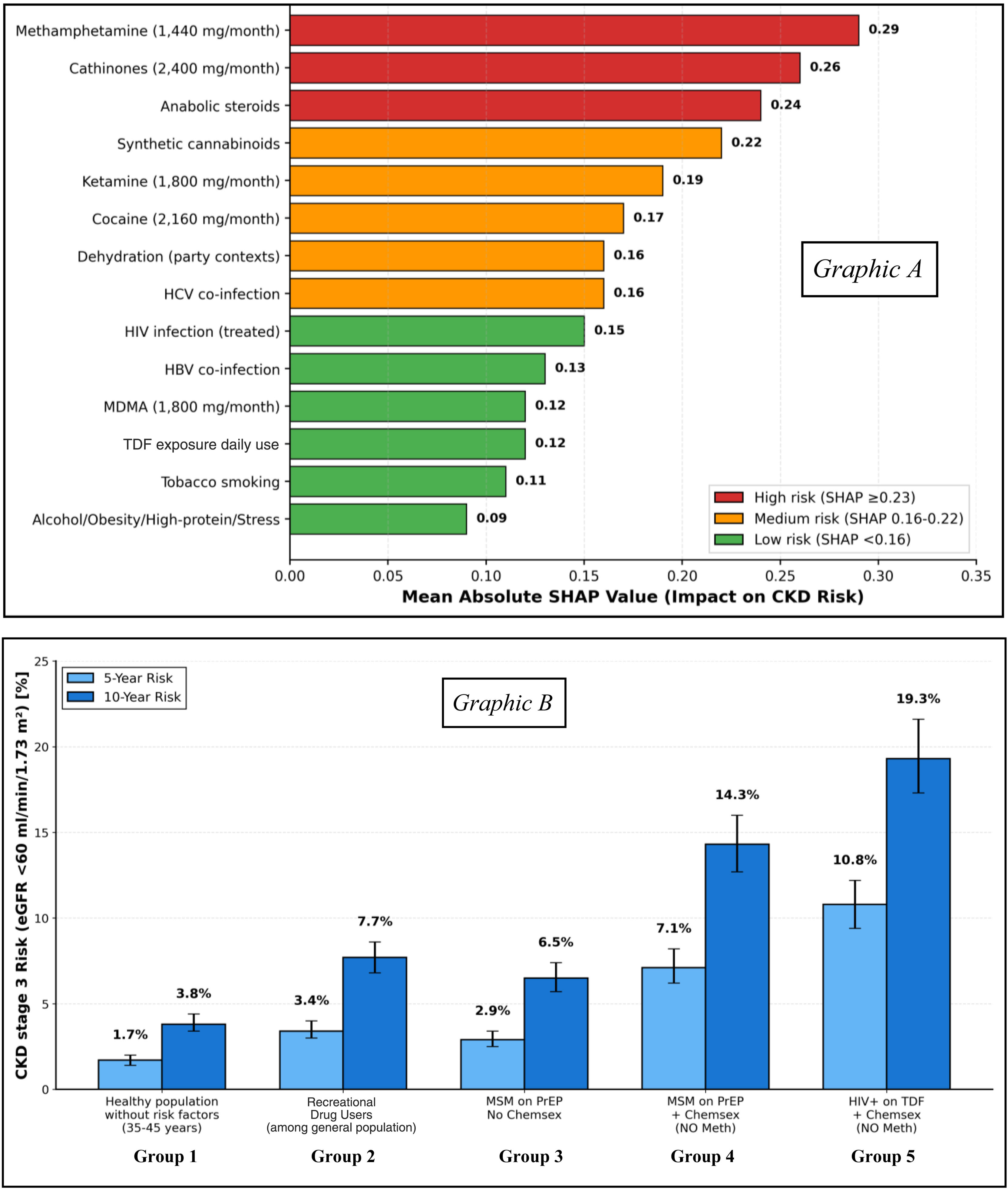
Given this knowledge gap, conducting a prospective study mimicking the sum of multiple risk factors as they occur in real life would be costly, complex, and unethical. Therefore, we developed a prediction model (Fig. 1) using an XGBoost survival algorithm with SHAP interpretability (Shapley Additive explanations is an IA interpretability framework that quantifies the specific contribution of each feature to a model's final prediction). This model has already been applied in prior biomedical studies, including renal and oncologic cohorts.
Simulation model for predicting chronic kidney disease in PrEP users and other potential nephrotoxic exposures. Graphic A: Risk feature importance for CKD development. SHAP values from XGBoost model. Average consumption in brackets. Graphic B: Chronic kidney disease risk at 5 and 10 years across population groups based on Kidney risk failure equation model. Methamphetamine was excluded
Herein, we resume the methodological steps: (1) a synthetic/virtual cohort of 15,000 individuals was generated and assigned to five clinically defined risk groups (healthy controls, recreational drug users, MSM on PrEP, MSM on PrEP practising chemsex, and HIV-positive individuals on TDF practising chemsex) calibrated to effect sizes from European epidemiological data.2,6,13 The aforementioned risk factors were assigned binary exposures based on group-specific European prevalences, with hazard ratios derived/calculates from published literature.3,26 Calculation of AKI-to-CKD transition risks was done using validated coefficients in prior publications.4,25 Two XGBoost classifiers (5 and 10 year horizons) were trained on an 80/20 stratified split with 5-fold cross-validation, evaluated by AUC-ROC, Hosmer–Lemeshow calibration, and Net Reclassification Improvement versus the Kidney Failure Risk Equation (KFRE), a well known prediction model in CKD.5,28 Model interpretability was assessed using SHAP (TreeExplainer), categorising feature impact into high (≥0.23), medium (0.16–0.22), and low (<0.16) risk levels.5 A sensitivity analysis was performed to quantify its isolated contribution to CKD risk across high-risk groups.
Artificial intelligence has been used because the origin and structure of data from different articles are very heterogeneous. Classical statistical methods would not be as complete for analysing data from varied sources and creating projections. Unlike conventional models (e.g. Cox regression), which assume linear covariate relationships and population-level fixed effects, the XGBoost survival algorithm inherently captures non-linear interactions across heterogeneous, multi-source data whilst demonstrating superior predictive accuracy. The integration of SHAP values further provides individualised, mathematically grounded interpretability, making this framework particularly suited to the complexity of multi-nephrotoxic risk modelling.29
Model performance was optimal [Overall AUC-ROC=0.84 (95% CI 0.82–0.86) vs 0.79 (95% CI 0.77–0.81) for KFRE (P<0.001)], with excellent calibration across risk deciles (Hosmer–Lemeshow χ2=8.4, P=0.39), where predicted risks closely matched observed outcomes. The process was assisted by Claude Sonnet 4.5 with rigorous observation of the process (more details and the plausibility prompt are available upon request)
Of particular note, GHB/GBL was excluded from the model due to a lack of evidence of intrinsic nephrotoxicity, notwithstanding its high prevalence as a recreational drug, especially in the context of chemsex. Other novel drugs (a-PVP, alpha-pentedrone, methylenedioxypyrovalerone (MDPV) or “monkey dust”, among others) were also not included due to insufficient information about kidney toxicity.
As shown in Graphic A, SHAP analysis provided a ranking of risk factors predicting long-term CKD development. Similarly, Graphic B compares the groups, illustrating how the synergistic effects of these noxious agents significantly elevate CKD risk. Although Group 2 shows only a modest risk increase, it represents a substantial proportion of individuals (3–9%, of general population, depending on geographical area, frequency, and substance studied).30
In addition, considering the rise in “novel” chemsex users with high cathinone consumption but probably lower methamphetamine use,13 we excluded methamphetamine from Groups 4 and 5 in Graphic B. However, if we recalculate including crystal meth, the risks increase to 9.9% and 19.8% for Group 4, and 15% and 25.9% for Group 5, at 5 and 10 years, respectively.
The model suggests that Groups 4 and 5 exhibit progression patterns similar to, but slower than, kidney diseases with mild proteinuria, such as incipient diabetic nephropathy or mild chronic glomerulonephritis. Although TDF use in HIV patients with renal impairment is uncommon in current clinical practice,11 we retained these groups because the model was based on TDF. Despite our conservative and clinically plausible approach, the simulation may still overestimate risks. Even if we reduce these risk estimates to one-third, they still indicate a considerable future CKD burden not currently accounted for. This simulation warrants cautious interpretation but provides a theoretical basis for anticipating a potential public health issue.
Finally, this article presents analyses, calculations, and projections derived exclusively from existing literature, as the conditions investigated cannot be experimentally reproduced due to ethical and legal constraints. Since no original data are presented and these projections do not imply causality, interpretation must be cautious, especially given that a significant proportion of the underlying data stems from retrospective, associative studies. Ultimately, this model offers a hypothetical framework for identifying potential renal risks associated with concurrent exposures within the LGTBQ+ community and should not be interpreted as conclusive evidence.
In conclusion, it is crucial to recognise the potential renal damage from PrEP with tenofovir disoproxil fumarate (TDF), especially when combined with other factors within and beyond the LGTBQ+ community. Furthermore, when renal involvement is suspected in a PrEP user, measuring cystatin C, total proteinuria, and phosphaturia should be considered.8 In addition, other non-nephrotoxic PrEP drugs such as Tenofovir alafenamide (TAF) or cabotegravir should be available and publicly funded as a kidney-safer alternatives. To address these challenges, the LGBTQ+ community requires strengthened collaborative research, preventive policies, and renal function surveillance using adapted tools that account for the limitations of each technique. Such efforts must expand beyond men who have sex with men to include all members, particularly transgender and gender-diverse individuals, lesbian cis-women, and bisexual cis-women.
ORCID IDEnrique A. Florit – 000-0002-8261-0464
Jorge N. Garcia-Perez 0000-0003-4986-6094
Yosu Luque-Rincón 0000-0002-3172-6571
Francisco Valga Amado – 0000-0002-3704-0255
Avinash Chandu-Nanwanid – 0009-0002-0633-6325
Jose Carlos De la Flor – 0000-0001-9346-2279
Authors’ contributionsAll authors have contributed significantly and approve the submission.
DeclarationsWe certify that this manuscript is original, has not been previously published, and is not under consideration elsewhere.
Generative AIDuring the preparation of this work, the authors used Jenni.ai to assist with writing the article in scientific English and Claude Sonnet 4.5 for analysis. After using these AI tools/services, the authors reviewed and edited the content as needed and take full responsibility for the published article.
FundingNo funding was received for this work.
Conflict of interestThe authors declare no conflicts of interest.