
Peritonitis remains a significant complication in patients undergoing peritoneal dialysis (PD), often necessitating hospitalization and catheter removal. While gram-positive organisms predominate, gram-negative pathogens, including Citrobacter species, are less commonly implicated. This report describes the first documented case of PD-associated peritonitis caused by Citrobacter sedlakii, a rare gram-negative bacillus of the Enterobacteriaceae family. We detail the clinical presentation, management, and outcomes of a 31-year-old female patient with recurrent peritonitis, highlighting the challenges posed by this unusual pathogen. This case underscores the need for heightened awareness of rare etiologies in PD-related infections and informs strategies for their management.
La peritonitis sigue siendo una complicación importante en pacientes sometidos a diálisis peritoneal (DP), que a menudo requiere hospitalización y la retirada del catéter. Aunque los microorganismos grampositivos predominan, los patógenos gramnegativos, incluidas las especies de Citrobacter, se implican con menor frecuencia. Este informe describe el primer caso documentado de peritonitis asociada a DP causada por Citrobacter sedlakii, un bacilo gramnegativo poco frecuente de la familia Enterobacteriaceae. Se detallan la presentación clínica, el manejo y los resultados de una paciente de 31 años con peritonitis recurrente, destacando los desafíos que plantea este patógeno inusual. Este caso subraya la necesidad de una mayor conciencia sobre etiologías raras en las infecciones relacionadas con la DP y aporta información para las estrategias de su manejo.
Peritoneal dialysis (PD) is a cornerstone of renal replacement therapy for patients with end-stage kidney disease, with its use expanding due to advancements such as automated PD systems.1 However, peritonitis remains a frequent and serious complication, accounting for 25–30% of hospitalizations among PD patients and often leading to technique failure.2–4 Microbiologically, gram-positive organisms predominate (40–50%), followed by gram-negative bacteria (20–30%), fungi (2–4%), mycobacteria (1%), polymicrobial infections (10%), and culture-negative cases (15%).5
Citrobacter species are gram-negative, oxidase-negative bacilli of the Enterobacteriaceae family and are infrequently pathogenic in humans. Typically isolated from urine, soft tissue, or sputum, they have been rarely associated with neonatal meningitis, sepsis, and abscesses.6–10 Within the Citrobacter genus, Citrobacter sedlakii is an uncommon isolate, with limited reports of serious infections.11,12
This case report presents the first documented instance of C. sedlakii-induced PD peritonitis, offering insights into its clinical course and management.
Case reportA 31-year-old female patient, in her 120th month of PD, presented with abdominal pain and cloudy peritoneal effluent. The patient had no known immunosuppressive condition other than end-stage kidney disease. Her PD history included two prior episodes of culture-negative peritonitis at 26 and 38 months. On examination, she was alert and oriented, with a temperature of 37°C, blood pressure of 110/70mmHg, and pulse of 90 beats per minute. Abdominal findings included voluntary guarding and rebound tenderness, with no evidence of catheter exit-site infection.
Laboratory results revealed a peripheral leukocyte count of 5780/mm3 and a C-reactive protein (CRP) level of 8.3mg/dL. Peritoneal fluid analysis demonstrated 1600cells/mm3 with 90% neutrophils. Empirical intraperitoneal therapy with ceftazidime (1g every 48h) and vancomycin (0.5g every 48h) was initiated. Cultures of the peritoneal fluid identified C. sedlakii, with susceptibility testing confirming sensitivity to the regimen. Tuberculosis cultures were negative.
By day 7, the peritoneal fluid cell count normalized, and symptoms resolved after 14 days of therapy, prompting discharge. However, 6 days later, the patient returned with recurrent abdominal pain and cloudy effluent. Laboratory findings showed leukocytosis (5970/mm3), elevated CRP (19.9mg/dL), and peritoneal fluid with 3560cells/mm3 (96% neutrophils). Repeat cultures confirmed persistent C. sedlakii growth. During recurrence, no additional pathology other than peritonitis was identified on evaluation Due to refractory infection, the PD catheter was removed, and treatment continued, resulting in clinical resolution. The favorable response to ongoing antibacterial therapy supported the accuracy of the initial microbiological diagnosis. Antifungal prophylaxis was not administered during the treatment period. The patient was transitioned to hemodialysis and discharged in stable condition.
DiscussionThe SPICE group (Serratia, Pseudomonas, indole-positive bacteria, Citrobacter, and Enterobacter) comprises a cluster of gram-negative pathogens associated with severe and recurrent peritoneal dialysis (PD)-related peritonitis.13,14
C. sedlakii, a facultative anaerobic and motile bacillus, is rarely implicated in human infections, although it has been reported in conditions such as neonatal meningitis and brain abscesses.6
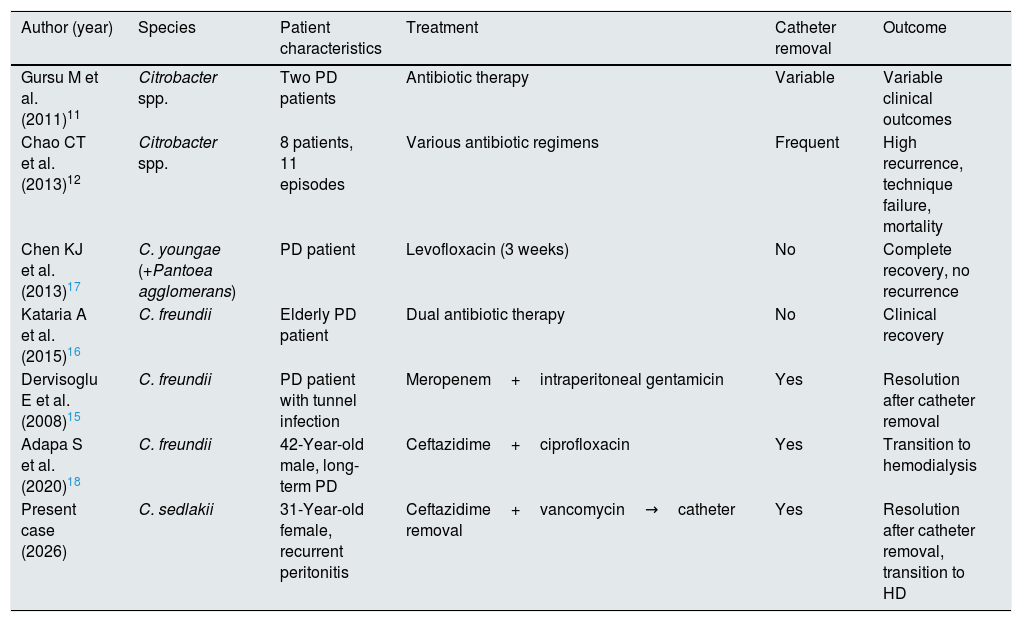
To better contextualize the present case, previously reported cases of Citrobacter peritonitis in PD patients are summarized in Table 1.
Reported cases of Citrobacter peritonitis in peritoneal dialysis patients.
| Author (year) | Species | Patient characteristics | Treatment | Catheter removal | Outcome |
|---|---|---|---|---|---|
| Gursu M et al. (2011)11 | Citrobacter spp. | Two PD patients | Antibiotic therapy | Variable | Variable clinical outcomes |
| Chao CT et al. (2013)12 | Citrobacter spp. | 8 patients, 11 episodes | Various antibiotic regimens | Frequent | High recurrence, technique failure, mortality |
| Chen KJ et al. (2013)17 | C. youngae (+Pantoea agglomerans) | PD patient | Levofloxacin (3 weeks) | No | Complete recovery, no recurrence |
| Kataria A et al. (2015)16 | C. freundii | Elderly PD patient | Dual antibiotic therapy | No | Clinical recovery |
| Dervisoglu E et al. (2008)15 | C. freundii | PD patient with tunnel infection | Meropenem+intraperitoneal gentamicin | Yes | Resolution after catheter removal |
| Adapa S et al. (2020)18 | C. freundii | 42-Year-old male, long-term PD | Ceftazidime+ciprofloxacin | Yes | Transition to hemodialysis |
| Present case (2026) | C. sedlakii | 31-Year-old female, recurrent peritonitis | Ceftazidime+vancomycin→catheter removal | Yes | Resolution after catheter removal, transition to HD |
The available literature remains limited and consists mainly of isolated case reports and small case series, including infections caused by different Citrobacter species such as C. freundii and C. youngae. The largest series by Chao et al. demonstrated that Citrobacter-related peritonitis is associated with high rates of recurrence, technique failure, and mortality.12
Similarly, individual case reports have shown variable clinical outcomes, ranging from complete recovery with antibiotic therapy to refractory infections requiring catheter removal and transition to hemodialysis.
This report represents the first documented association of C. sedlakii with PD-related peritonitis. The recurrence of infection despite initial clinical and microbiological improvement suggests potential pathogenic mechanisms such as biofilm formation on the PD catheter or transmural migration of gastrointestinal flora, findings that are consistent with previous reports of Citrobacter peritonitis.15,16
In addition, organisms within the SPICE group are known to exhibit inducible beta-lactam resistance, which may contribute to relapse despite apparent initial treatment success.
Overall, Citrobacter peritonitis appears to be associated with considerable morbidity, including increased hospitalization rates, catheter loss, and, in some series, significant mortality. In the present case, although initial therapy led to clinical improvement, recurrence occurred shortly after treatment completion. This clinical course highlights the importance of careful follow-up and suggests that prolonged or more aggressive treatment strategies may be required in selected cases.
In our patient, catheter removal was ultimately necessary to achieve definitive resolution, which is consistent with previously reported refractory cases of gram-negative peritonitis.13
Notably, no intra-abdominal source of infection or additional immunosuppressive condition was identified, and persistent isolation of the same organism supports the role of the pathogen itself in disease persistence.
This case adds to the limited body of literature on C. sedlakii infections and underscores its potential as an emerging pathogen in PD patients. Clinicians should be aware that even rare Citrobacter species may lead to recurrent and treatment-resistant peritonitis. Early consideration of catheter removal should be kept in mind in refractory or relapsing cases.
Further studies are needed to better define the epidemiology, risk factors, and optimal management strategies for Citrobacter-associated peritonitis in PD patients.
Ethics statementThe study protocol was approved by the Clinical Research Ethics Committee of University of Health Sciences Gazi Yaşargil Training and Research Hospital (approval date: October 3, 2025; approval number: 662). The study was conducted in accordance with the principles of the Declaration of Helsinki.
FundingThis study did not receive any specific grant from funding agencies in the public, commercial, or not-for-profit sectors.
Conflict of interestThe authors declare that they have no conflict of interest.
Data availabilityThe datasets generated and/or analyzed during the current study are available from the corresponding author on reasonable request.