
Advanced chronic kidney disease requires a longitudinal and integrated approach that combines the different modalities of kidney replacement therapy (KRT). In this context, kidney transplantation is considered the optimal option for eligible patients. However, pre-emptive transplantation is not always feasible, and many patients require dialysis before transplantation or following graft failure. This narrative review examines the role of peritoneal dialysis (PD) within an integrated KRT model, with particular emphasis on its use as first-line therapy, as a bridge to kidney transplantation and after graft failure. The available evidence, derived mainly from observational studies, registries, and meta-analyses, indicates that PD provides outcomes at least comparable to conventional haemodialysis in terms of patient survival. In addition, PD may offer specific advantages in the transplant setting, including a lower risk of delayed graft function and a higher likelihood of access to kidney transplantation or re-transplantation in selected patients. Furthermore, as a home-based therapy, PD may enhance patient autonomy, health-related quality of life, employability, and the sustainability of healthcare systems. Nevertheless, despite Spain's leading position in kidney transplantation, the relatively low uptake of PD highlights persistent organisational, structural, and cultural barriers that limit its effective integration into routine care. Within this framework, PD should be considered as a preferred option within a continuous, patient-centred KRT model. Key priorities include increasing PD initiation rates to 30%, consolidating its superior role as a bridge to transplantation, and enabling efficient transitions back to PD after graft failure to preserve quality of life while maintaining re-transplantation options.
La enfermedad renal crónica avanzada requiere un abordaje longitudinal e integrado que incorpore las distintas modalidades de tratamiento renal sustitutivo (TRS) a lo largo del recorrido asistencial del paciente. En este contexto, el trasplante renal (TxR) se considera la opción óptima para los pacientes candidatos. Sin embargo, el TxR anticipado no siempre es factible, y muchos pacientes precisan diálisis antes del TxR o tras el fracaso del injerto. Esta revisión narrativa analiza el papel de la diálisis peritoneal (DP) dentro de un modelo integrado de TRS, con especial énfasis en su utilización como tratamiento de primera línea, como puente al TxR y tras el fallo del injerto. La evidencia disponible, procedente fundamentalmente de estudios observacionales, registros y metaanálisis, indica que la DP ofrece resultados al menos comparables a la hemodiálisis convencional en términos de supervivencia del paciente. Además, la DP puede aportar ventajas específicas en el contexto del TxR incluyendo un menor riesgo de función retardada del injerto y una mayor probabilidad de acceso re-TxR en los pacientes seleccionados. Como técnica domiciliaria, también puede favorecer la autonomía, la calidad de vida relacionada con la salud, la empleabilidad y la sostenibilidad de los sistemas sanitarios. No obstante, pese al liderazgo de España en TxR, la baja utilización de la DP pone de manifiesto la persistencia de barreras organizativas, estructurales y culturales que limitan su integración en la práctica clínica. En este marco, la DP debería considerarse una opción preferente dentro de un modelo continuo y centrado en el paciente. Las prioridades incluyen aumentar su inicio hasta el 30%, consolidar su papel como puente al trasplante y facilitar la transición de vuelta a DP tras el fracaso del injerto.

Chronic kidney disease (CKD) has emerged as a major global public health challenge. In May 2025, the World Health Organisation declared it a global health priority due to its high impact on both populations and healthcare systems, marking a milestone in the public health agenda that advocates research and multi-stakeholder collaboration in kidney disease.1 In Spain, CKD was also recognised within the National Health Strategy for Chronicity 2025–2028.1,2 This resolution encourages countries to promote CKD prevention and control and improve diagnosis and equitable access to kidney replacement therapy (KRT).
In Spain, CKD affects approximately 15% of the adult population, with prevalence increasing significantly with age.3 Epidemiological projections indicate that CKD is expected to become one of the leading causes of mortality in Western Europe by 2050, surpassing both ischaemic heart disease and stroke.4 Based on projections from current data, it has been estimated that up to 8.5 million individuals could be affected by CKD in Spain by that time. This trend is accompanied by a substantial increase in the demand for kidney replacement therapy (KRT) and associated healthcare costs, posing major challenges for healthcare systems.4
The incidence and prevalence of KRT continue to rise. In 2024, the incidence reached 150 patients per million adult population, with more than 1400 patients per million receiving dialysis or living with a functioning kidney transplant.5 This increase reflects not only CKD progression but also improved survival and broader access to treatment.
Although patients undergoing KRT represent a small proportion of the population, they account for a disproportionate share of healthcare expenditure.6 In ageing societies, this scenario mandates proactive planning of KRT modalities and their integration within sustainable care models.6–8
In this context, kidney transplantation (KTx), particularly pre-emptive living donor KTx, remains the optimal KRT option in terms of survival, health-related quality of life (HRQoL), and functional recovery.9 However, its availability is limited, and most patients will require dialysis at some point, either before KTx or following graft failure. In-centre haemodialysis (HD) is currently the predominant modality, while home therapies, such as peritoneal dialysis (PD) and home haemodialysis (HHD), are minority options.5
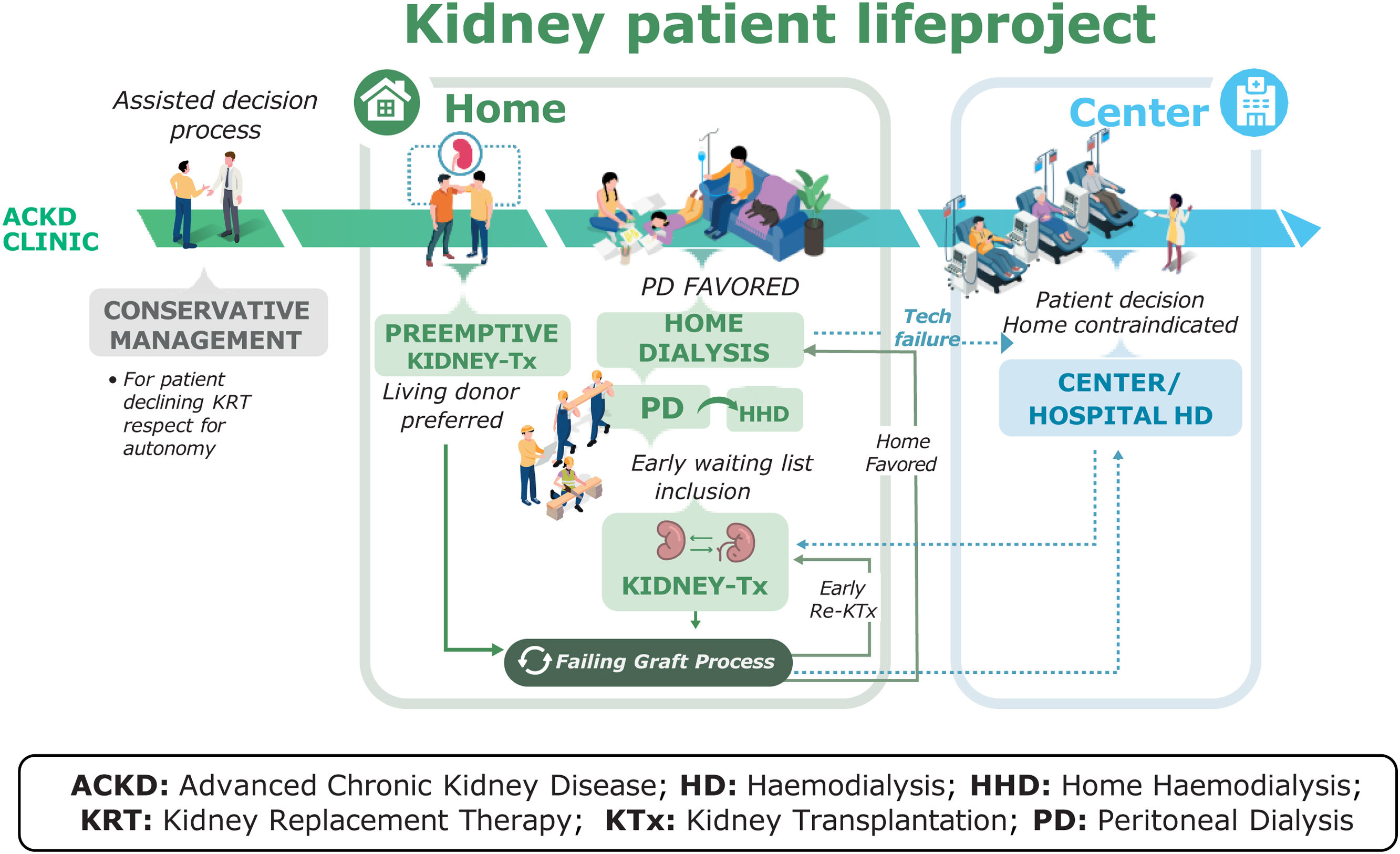
Therefore, KRT modalities should not be considered in isolation, but rather as components of a longitudinal care pathway, the so-called “kidney patient journey”. From this perspective, the interaction between dialysis and KTx becomes central, particularly because graft failure may necessitate a return to dialysis, creating a “two-way ticket” along the KRT continuum.10 Ensuring continuity of care, comprehensive patient assessment, equitable access and shared decision-making should be considered essential elements of this model (Fig. 1). From the patient's perspective, the choice of KRT modality should be based not only on optimal clinical outcomes but also on preserving the individual's life goals, including family roles, social participation, autonomy, employability, and emotional well-being.

Two key questions arise from this model: Are there significant differences in outcomes between the various KRT modalities? And can an optimal treatment sequence be defined for individual patients? Evidence addressing these questions is limited. No randomised studies have been designed to compare KRT modalities across the patient trajectory, and most available data derive from observational studies, registries and meta-analyses based on them. Although advanced statistical methods are frequently used to adjust for confounding, important factors such as healthcare organisation, centre experience, and patient preference remain difficult to control. Consequently, the optimal sequencing of KRT modalities continues to be an area of uncertainty. Optimisation should therefore be based on a comprehensive patient-centric approach, incorporating health outcomes results considering the patient experience, social value and both economic and environmental sustainability.7
The aim of this review is to analyse the integration of KRT modalities, with particular emphasis on PD and its relationship to KTx, throughout the CKD patient journey within the Spanish healthcare system. To this end, we examined PD as initial therapy, as a bridge to KTx and as a modality following graft failure, while identifying current organisational barriers and opportunities to improve continuity of care.
MethodsThis narrative review is based on a structured expert discussion held during the symposium “Kidney Transplantation and Peritoneal Dialysis: Integration of Therapies in the Continuity of Care of Chronic Kidney Disease Patients”, which took place at the 55th Congress of the Spanish Society of Nephrology (October 16–18, 2025). The symposium brought together experts in KTx, PD, hospital and home HD, providing a multidisciplinary perspective on the integration of KRT across the advanced CKD (ACKD) care pathway.
Prior to the symposium, the authors identified key clinical questions related to the role of PD across the KTx pathway, including dialysis bridging to KTx, and return to dialysis after graft failure. Each topic was addressed through a targeted narrative review of the available literature, including clinical practice guidelines, registry data, observational studies, and systematic reviews.
Following the symposium and audience discussion, the content was expanded and refined through an updated literature review to strengthen the scientific basis and improve applicability beyond the congress setting. Evidence was critically appraised and integrated with expert clinical experience, with particular emphasis on continuity of care and treatment sequencing within the Spanish healthcare system.
Given the nature of the available evidence, this review was not designed as a systematic review but as a narrative synthesis aimed at contextualising current data and identifying practical implications for clinical practice. No formal quality scoring was applied, given the heterogeneity of study designs and outcomes.
Peritoneal dialysis as initial therapy in the integrated kidney replacement therapy modelCurrent evidence comparing outcomes in patients initiating KRT with PD or HD is largely derived from regional, national, and international registries. Overall, observational studies consistently suggest that patient survival with PD is at least comparable to those starting HD and may be superior in selected populations.11,12 These findings are supported by recent systematic reviews and meta-analyses. In this regard, Chander et al. reported an association between PD and lower mortality compared with HD (relative risk [RR] 0.78; 95% confidence interval [CI] 0.62–0.97; p=0.03).11 Similarly, a Cochrane review has suggested a reduction in all-cause mortality with PD (RR 0.53; 95% CI: 0.32–0.86; moderate certainty evidence).12
Several mechanisms may contribute to these findings, including the continuous nature of PD, more stable clearance of uraemic toxins, and better preservation of residual kidney function (RKF).13 However, the absence of randomised clinical trials precludes definitive causal inferences and highlights the inherent limitations of the available evidence. Beyond clinical outcomes, PD offers relevant advantages from both patient and healthcare system perspectives. Its home-based nature facilitates flexible treatment delivery, incremental prescription strategies, and preservation of vascular access, while promoting patient autonomy and better adaptation to individual needs.13,14 These characteristics are consistently associated with improved HRQoL.
On this basis, some healthcare systems have adopted PD-first strategies, in which PD is promoted as the initial dialysis modality, reserving HD for cases in which PD is contraindicated or not feasible.15 The experience in Hong Kong represents the most consolidated example of this approach, with long-standing implementation and favourable outcomes.16 In parallel, other countries have developed PD-favoured or PD-preferred models, in which PD is actively encouraged through structured pre-dialysis education, shared decision-making, reimbursement support, home dialysis infrastructure, and assisted PD programmes, without mandating PD initiation. The aim of these strategies is to enhance patient autonomy, HRQoL, clinical outcomes, and healthcare sustainability while promoting home-based therapies. Examples of healthcare systems adopting this approach include New Zealand, Australia, Finland, and Canada.17
Peritoneal dialysis as a bridge therapy to kidney transplantationWhen pre-emptive KTx is not feasible, a dialysis modality must be implemented that serves as an effective bridge therapy to KTx within a planned treatment-sequencing model. In this context, PD has been shown to play a particularly relevant role.
A Spanish multicentre study has described this transition in detail, coining the concept of a “two-way ticket” between PD and KTx.10 In this cohort of approximately 1000 patients receiving PD, 51% were placed on the transplant waiting list, compared with a national mean of around 15%, largely composed of patients on HD. In addition, a substantial proportion of these patients underwent KTx within the first 18 months after inclusion on the transplant waiting list.10 These differences are likely explained, at least in part, by the clinical and organisational profile of patients who initiate PD. Compared with patients starting HD, those commencing PD tend to be younger, have a lower comorbidity burden, are more frequently followed-up in advanced CKD (ACKD) clinics, and more frequently start dialysis in a planned manner.10 This context facilitates early KTx evaluation and timely inclusion on the waiting list. Likewise, patients not requiring HD sessions prior to KTx may have a logistical advantage in situations where the cold ischaemia time is limited.
Observational studies and meta-analyses suggest that patients undergoing KTx after PD may experience better early post-KTx outcomes than those treated with HD. Molnar et al. reported a lower unadjusted risk of death in PD patients (RR 0.67; 95% CI: 0.55–0.82).18 Likewise, a meta-analysis showed that pre-KTx PD was associated with a lower risk of delayed graft function (DGF) (odds ratio [OR] 0.73; 95% CI: 0.70–0.76) and overall graft failure (hazard ratio [HR] 0.96; 95% CI: 0.92–0.99).19
Potential explanations for these findings include better preservation of RKF, greater haemodynamic stability, improved volume control, and lower exposure to intradialytic hypotension compared with HD.19 In addition, patients treated with PD often show greater engagement in self-care, a factor that may favour treatment adherence after KTx.20
Although the use of PD during post-surgical DGF is uncommon in the Spanish healthcare setting, available evidence suggests that PD can be safely continued when low-volume infusion protocols are applied, and appropriate patient selection is ensured. Clinical outcomes appear comparable to those observed with HD, with no differences in rates of acute rejection or in graft and patient survival.21–24 In this context, PD may be considered for the management of DGF in selected patients, provided that the peritoneal catheter remains in situ, and there are no alterations in peritoneal integrity, significant surgical complications, or factors associated with an increased risk of infection.21–24 In selected cases, PD may therefore represent a valid alternative that avoids central venous catheter placement.
Peritoneal dialysis in patients with a “failing graft”Patients transitioning back to dialysis due to a progressively declining kidney graft represent a distinct clinical subgroup with increased complexity of care. The term failing graft is commonly used to describe the period of progressive graft dysfunction preceding the need for dialysis or re-KTx, a stage that is clinically analogous to advanced pre-dialysis chronic kidney disease. This phase requires anticipatory planning and coordinated decision-making regarding dialysis modality selection, initiation timing, and immunosuppression (IS) management. According to data from the Spanish Registry of Renal Patients (REER), approximately 2.7% of incident patients initiating KRT correspond to this clinical scenario, a proportion comparable to that reported in other international registries such as ANZDATA.5
Care responsibility for these patients often shifts from transplant units to ACKD clinics and dialysis teams. This transition involves complex decisions related to dialysis modality selection, optimal timing of initiation, and stepwise IS withdrawal, frequently occurring in a context perceived as treatment failure by patients, caregivers, and healthcare professionals.25
There is currently no consensus regarding who should lead the transition to dialysis in patients with a failing graft. North American transplant guidelines recommend shared follow up between transplant specialists and advanced CKD nephrologists,26 while KDIGO guidelines advocate a multidisciplinary approach to ensure a smooth transition to dialysis.27 In contrast, UK transplant guidelines advise referral of patients with an estimated glomerular filtration rate below 20mL/min/1.73m2 to ACKD clinics at least six months before the anticipated start of dialysis.28 This strategy aims to facilitate comprehensive management, enable informed and free modality choice, and promote a planned initiation of KRT.
Evidence directly comparing these models of care is limited. In one retrospective study, two centres applying different follow-up strategies (ACKD clinic-led versus transplant specialist led follow-up) were compared. Patients managed in ACKD clinics received more comprehensive information on dialysis modalities and experienced a lower incidence of unplanned or urgent dialysis initiation. However, no significant differences were observed in dialysis modality distribution, estimated glomerular filtration rate at dialysis initiation, or time to re-KTx.29
Several studies have reported increased mortality in patients restarting dialysis after graft failure compared with transplant naïve patients. Identified risk factors include older age, diabetes, cardiovascular disease, hypoalbuminaemia, high comorbidity burden, and unplanned in-hospital dialysis initiation.30–32 A large meta-analysis that included 249,716 individuals, demonstrated that mortality risk is highest during the first year after restarting dialysis, with cardiovascular events and infection being the leading causes of death.30–32 However, other studies found no significant differences in mortality compared to patients without previous transplant, although they do describe a higher risk of technique failure, infections, and more rapid loss of RKF.33,34 In this regard, a meta-analysis of 12 studies comparing incident PD patients without a previous transplant versus those who restarted PD after graft failure showed no significant differences in infection rates, technique failure, or mortality.35
The available data consistently show limited use of PD as a technique after failed KTx, although this finding varies widely geographically, both between countries and between regions within Spain. Thus, the ANZDATA registry (Australia and New Zealand) described a PD uptake rate ranging from 5% to 16%. In contrast, the Andalusian registry showed that approximately 3.2% of patients accessed re-KTx without receiving dialysis, 88.9% initiated HD and only 7.9% initiated PD.36 In the broader European dialysis population, an ERA Registry study analysing European dialysis trends and transitions between techniques (2012–2021) found that, although overall use of home dialysis remained stable (accounting for 5.8% of KRT), initiation rates and prevalence of HHD increased, whereas PD declined.37 In the absence of controlled clinical trials, the comparison of outcomes between PD and HD in this context is primarily based on epidemiological and observational studies. In this regard, the study by Perl et al., which included 1865 patients who started PD versus 14,248 who started HD after a graft failure, showed a lower mortality risk in the PD group (HR 0.92, 95% CI 0.85–0.99). However, this benefit was limited to the first year of follow-up, both in the multivariate (HR 0.85, 95% CI 0.74–0.97) and propensity-matched analyses (HR 0.83, 95% CI 0.69–0.99), and significance was lost in later years.38 A study by Chaudhary et al. found a similar early-stage benefit, consistent with the rationale supporting a PD-first strategy in naïve patients.39 A Spanish multicentre retrospective cohort compared PD and HD in 175 patients returning to dialysis after graft failure. In a competing-risk multivariate analysis, PD was associated with a lower risk of mortality (HR 0.36; 95% CI 0.15–0.89; p=0.028), a reduced risk of hospital admission (HR 0.52; 95% CI 0.37–0.74; p<0.001), and a lower likelihood of developing graft intolerance syndrome (HR 0.31; 95% CI 0.14–0.76; p=0.009).40 Additionally, in a study from the Catalan Registry including 2045 patients, PD after graft failure was associated with lower mortality than HD in patients awaiting re-KTx, with comparable sensitisation rates and second graft outcomes.41 Taken together, these findings support considering PD as a preferred dialysis modality after graft failure in selected patients, particularly candidates for re-KTx.
The potential advantages of choosing PD in the context of a graft failure are similar to those described for naïve patients with ACKD: greater flexibility, possibility of progressive (incremental) therapy, better preservation of RKF, protection of vascular capital for the future, and respect for patient choice, but there is also an important psychological benefit. Using PD as a bridge to a second transplant allows the patient to remain in the home setting, minimising the sense of failure and avoiding the impact that in-centre HD can have on work and social life. If the patient has previously been on PD, the transition is usually more natural, so resumption of the technique should be facilitated and actively supported. Likewise, PD should also be considered in patients who started treatment with HD, taking into account that, 10–15 years ago, many hospitals in Spain offered only limited PD programmes or none at all, which could have resulted in unequal access to this modality.
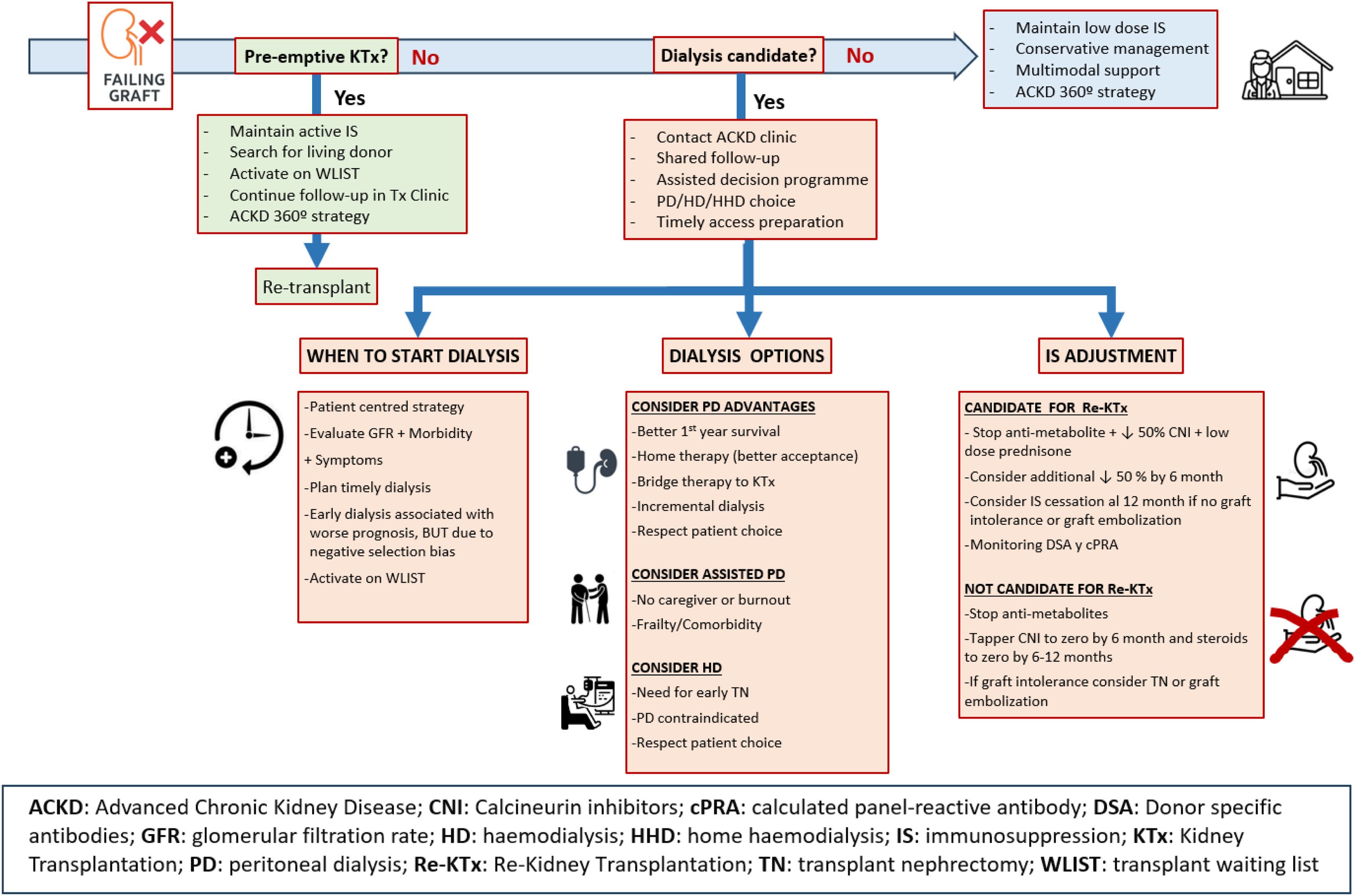
There is no single optimal strategy for the management of IS after kidney graft failure (Fig. 2). Decisions must balance the potential benefits of continuing IS, such as preservation of RKF and reduction of immune sensitisation,42,43 against the increased risks of infection, malignancy, and other IS related complications.44

Continued low-dose IS may help preserve RKF and limit the development of human leucocyte antigen (HLA) sensitisation, a factor that is particularly relevant for patients who are candidates for re-KTx.42,43 In a classic decision-analysis study, Jassal et al. reported higher estimated mean survival among patients who continued IS after returning to dialysis, with the greatest benefit observed in those with preserved RKF.44 In contrast, continued IS is associated with an increased risk of infectious complications and, potentially, malignancy.44,45 These risks become particularly relevant in older patients and those with high comorbidity burdens, and must be carefully weighed against the potential benefits on a case-by-case basis.
IS withdrawal is generally indicated in cases of early graft failure such as primary non-function, vascular thrombosis, or early rejection, in order to reduce the risk of serious complications such as graft rupture or haemorrhage.46 In contrast, in late graft failure, maintenance of low-dose IS may be considered in order to preserve RKF and minimise HLA sensitisation in potential retransplant candidates.42 Abrupt or complete withdrawal of IS may precipitate graft intolerance syndrome and promote the development of anti-HLA antibodies, thereby increasing the risk of sensitisation and potentially compromising future re-KTx.47–49 Current practice guidelines reflect this complexity. The British Transplantation Society guidelines recommend a stepwise reduction of IS, starting with antimetabolites, followed by calcineurin inhibitors, and finally corticosteroids.50 This pragmatic approach aims to balance immunological risk and safety, while allowing flexibility according to patient characteristics and retransplant potential.
Overall, available evidence and guideline recommendations support an individualised, stepwise approach to IS withdrawal, balancing the benefits of preserving RKF and limiting sensitisation against the risks associated with prolonged IS exposure.
Home therapies, sustainability of the healthcare system, and “green” dialysisSustainability has become a cross-cutting dimension in the planning of KRT, encompassing environmental, economic, and organisational considerations. Home-based therapies, particularly PD, have been increasingly discussed as potential contributors to more sustainable care models, although available evidence remains heterogeneous and partly indirect. Consequently, their role is best framed in terms of opportunity and potential rather than definitive impact.20,51–53
From an environmental perspective, the concept of green dialysis has emerged in response to growing awareness of the ecological footprint of KRT.54 This approach promotes strategies aimed at reducing the consumption of water, energy and materials, as well as minimising waste generation.54 Home-based therapies may contribute to a lower carbon footprint, primarily by reducing patient travel associated with in-centre HD.20 However, the systematic incorporation of environmental indicators into clinical guidelines and regulatory frameworks remains limited.
The social dimension of sustainability is equally relevant. Home-based therapies reduce the burden associated with frequent travel to healthcare facilities and the time required for treatment, factors that are particularly important for patients with functional limitations, those living in rural areas, or in healthcare systems experiencing high demand.53 In this context, PD facilitates a greater patient autonomy and integration of treatment into daily life.
The implementation of home-based strategies is not without challenges. PD requires structured education, training and follow-up programmes, as well as adequate organisational support. It also entails a partial shift of logistical responsibilities to the home setting, an aspect that must be realistically considered in resource planning and in the evaluation of its overall impact.53
From a human resources perspective, PD is associated with more flexible organisational models and, in general, with more favourable staff-to-patient ratios than HD, making it easier to implement in settings with limited workforce availability.51 Nevertheless, expansion of PD requires appropriate training of healthcare professionals, together with alignment of health policies, incentives, and organisational structures.51
Finally, the applicability of these models to the Spanish setting should be considered in light of the existing heterogeneity in infrastructure, modality culture, and organisation of nephrology services. Overall, sustainability provides a useful conceptual framework for integrating PD into a more efficient and resilient KRT model, while recognising that its contribution will ultimately depend on the manner in which it is implemented and the context in which it is delivered.
Patient perspective: employability, PROMs, and PREMsThe ability to maintain or regain employment represents a clinically meaningful outcome in patients with ACKD, particularly for individuals awaiting KTx. Although employability is often under-represented in traditional clinical assessments, it has a direct impact on autonomy, psychosocial well-being, family burden, and social sustainability.20 Available evidence consistently suggests higher employment rates among patients treated with PD and KTx recipients compared with those receiving in-centre HD, although results vary according to clinical and social factors.51 This association is likely related, at least in part, to the home-based nature of PD and its lower time burden, which may facilitate the continuation of work activity.55
These observations are consistent with the findings from HRQoL instruments, such as the Kidney Disease Quality of Life (KDQOL) questionnaire, where PD was associated with favourable trends in certain domains, including work status.56 Moreover, observational studies and meta-analyses indicate that PD yields comparable or slightly better HRQoL outcomes than HD, especially in mental-health domains and those related to treatment burden.56–59
Beyond traditional clinical outcomes, patient-reported measures provide essential insights into treatment experience. Patient-reported outcome measures (PROMs) and patient-reported experience measures (PREMs), capture dimensions such as autonomy, treatment burden and care experience. Studies based on PREMS suggest that PD is associated with a more personalised care experience aligned with patient preferences, consistent with the person-centred approach promoted by the International Society for Peritoneal Dialysis (ISPD).60
PD may also promote patient empowerment and activation, as it involves the autonomous management of treatment at home. From a clinical perspective, this experience may facilitate adaptation to the post-transplant period, which is characterised by increased treatment complexity and strict adherence requirements.61
Overall, although the evidence remains largely observational, available data support the incorporation of patient-centred outcomes, including employment, HRQoL and care experience, into the evaluation and planning of KRT modalities. In this context, PD aligns particularly well with patient-relevant goals and should be considered within shared decision-making processes across the CKD care pathway.
Organisational challenges in the integration of peritoneal dialysis and kidney transplantationDespite Spain's internationally recognised leadership in KTx, PD remains underutilised along the transplant care pathway. Given the potential role of home-based therapies both before and after KTx, greater prioritisation of PD could reasonably be expected. However, real-world practice shows a persistently low uptake of PD, suggesting the presence of organisational, structural, and cultural barriers that limit its integration.62 Recent registry data indicate that most incident patients still initiate KRT with in-centre HD, while fewer patients start PD or undergo pre-emptive KTx.58 Marked interregional variability persists, reflecting that modality choice is not determined solely by clinical suitability, but is also strongly influenced by organisational, programme structure, coordination between care levels, and local modality culture.5,17,37
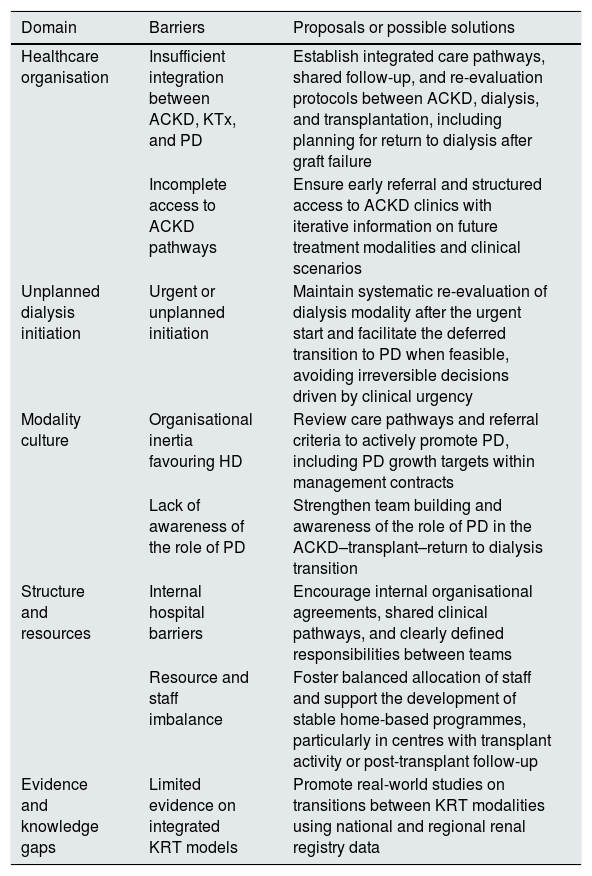
From an operational perspective, unplanned dialysis initiation represents a critical barrier to integration. Urgent starts often bias initial modality selection towards HD and may preclude timely shared decision-making (Table 1). However, maintaining active reassessment of modality choice after an urgent start and enabling deferred transition to PD when feasible could prevent irreversible decisions driven by clinical urgency rather than long-term planning.
Barriers and proposals for the integration of PD along the pathway to transplantation and after graft failure.
| Domain | Barriers | Proposals or possible solutions |
|---|---|---|
| Healthcare organisation | Insufficient integration between ACKD, KTx, and PD | Establish integrated care pathways, shared follow-up, and re-evaluation protocols between ACKD, dialysis, and transplantation, including planning for return to dialysis after graft failure |
| Incomplete access to ACKD pathways | Ensure early referral and structured access to ACKD clinics with iterative information on future treatment modalities and clinical scenarios | |
| Unplanned dialysis initiation | Urgent or unplanned initiation | Maintain systematic re-evaluation of dialysis modality after the urgent start and facilitate the deferred transition to PD when feasible, avoiding irreversible decisions driven by clinical urgency |
| Modality culture | Organisational inertia favouring HD | Review care pathways and referral criteria to actively promote PD, including PD growth targets within management contracts |
| Lack of awareness of the role of PD | Strengthen team building and awareness of the role of PD in the ACKD–transplant–return to dialysis transition | |
| Structure and resources | Internal hospital barriers | Encourage internal organisational agreements, shared clinical pathways, and clearly defined responsibilities between teams |
| Resource and staff imbalance | Foster balanced allocation of staff and support the development of stable home-based programmes, particularly in centres with transplant activity or post-transplant follow-up | |
| Evidence and knowledge gaps | Limited evidence on integrated KRT models | Promote real-world studies on transitions between KRT modalities using national and regional renal registry data |
ACKD: advanced chronic kidney disease; HD: haemodialysis; KRT: kidney replacement therapy; KTx: kidney transplantation; PD: peritoneal dialysis.
Lack of continuity of care between KTx units, ACKD clinics and dialysis programmes further hampers longitudinal planning. Fragmentation across care levels may lead to late decision-making, loss of follow-up at transplant centres, and unplanned transitions, particularly in patients returning to dialysis after graft failure. Integrated care models linking these settings, including shared follow-up of retransplant candidates, could support earlier and more consistent therapeutic decisions.25
Structural heterogeneity between centres represents an additional challenge. Not all hospitals have dedicated post-transplant follow-up clinics or well-established PD programmes, which may result in unequal access to modalities and unplanned transitions, particularly for patients with graft failure who require transfer between centres. Standardisation of clinical pathways and strengthened coordination are therefore essential to ensure equity in access to all KRT options.
Overall, achieving a truly integrated KRT model requires viewing the patient journey as a continuous process rather than a sequence of isolated episodes. Within this framework, PD can play a relevant role both before and after KTx, provided it is incorporated in a planned and proactive manner. It successful integration depends less on technical availability than on organisational alignment, anticipatory decision-making, and coordination between teams and levels of care.
ConclusionsPD should be regarded as an integral component of the care pathway for patients with ACKD candidates for KTx, rather than a secondary or fallback modality. Available evidence supports its use at KRT initiation, during the waiting period for a KTx, and, in selected patients, after graft failure. Compared with HD, PD offers comparable survival outcomes and may provide specific advantages within the transplant pathway, including a lower risk of DGF and improved access to KTx or re-KTx. Beyond clinical outcomes, its home-based nature promotes continuity of care, patient autonomy, and integration of treatment into daily life. However, despite Spain's leadership in KTx, the persistently low uptake of PD reflects organisational and cultural barriers, particularly at critical transition points, such as unplanned dialysis initiation and return to dialysis after graft failure. Addressing these challenges requires proactive planning of transitions between ACKD, dialysis, and KTx, ensuring continuity of care, equitable access to all modalities, and shared decision-making. Within this framework, PD should be considered a strategic tool within a longitudinal, patient-centred KRT model focused not only on survival or dialysis adequacy, but also on preserving autonomy, dignity, and the ability of people living with CKD to continue with their daily lives.
ORCID IDVerónica López-Jiménez: 0000-0001-9415-2942
Josep María Cruzado: 0000-0003-1388-8558
Patricia de Sequera-Ortiz: 0000-0001-7705-9228
Daniel Gallego-Zurro: 0009-0006-1447-9384
Emilio Sánchez-Álvarez: 0000-0002-4431-3223
FundingThis manuscript is based on a symposium sponsored by Vantive, who funded editorial support for its preparation. Vantive has not contributed to the content of the work or the authors’ decision to publish it.
Conflict of interestsJ-P have received speaker fees and support for research from Vantive, Fresenius, Astellas and CSL-Vifor.
V-LJ has received honoraria for conferences, consulting fees and advisory boards from Vantive, Astellas, Chiesi, Sobi and GSK.
P-SO has received honoraria for conferences, consulting fees and advisory boards from CSL-Vifor, Amgen, GSK, Fresenius, Nipro, Astra Zeneca, Bial, Astellas, Braun and Vantive. MF-SR, JM-C, D-GZ and E-SA report no conflicts of interest related to this manuscript.
The authors would like to thank Medical Statistics Consulting S.L., Valencia, Spain for providing scientific and medical writing support in accordance with Good Publication Practice (GPP3) guidelines (http://www.ismpp.org/gpp3).