



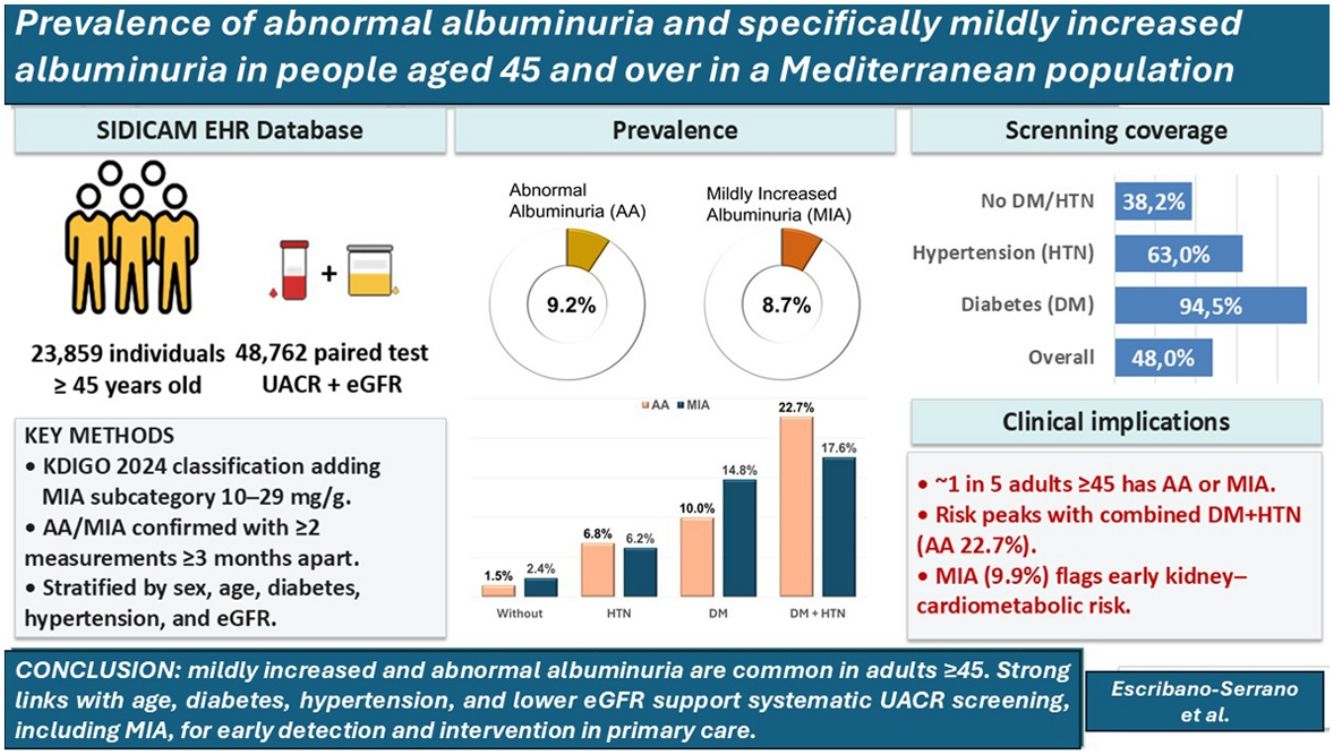
Albuminuria is recognized as an early marker of kidney injury, an independent predictor of cardiovascular events, and mortality. Yet the frequency of abnormal albuminuria (AA; UACR≥30mg/g) and specifically mildly increased albuminuria (MIA; 10–29mg/g) in Mediterranean populations is still poorly characterized.
MethodsA cross-sectional, multicentre study including all urine albumin-to-creatinine ratio (UACR) and estimated glomerular filtration rate (eGFR) records from July 1, 2021, to June 30, 2023, in individuals ≥45 years [23,859 adults (median age 64 years; 54% women)] within a Health Management Area was done. We used KDIGO 2024 classification, adding a new sub-category for MIA. Prevalence with 95% confidence intervals (CI) was calculated and stratified by sex, age, diabetes, and hypertension.
FindingsThe overall prevalence of AA was 9.2% (95% CI 8.8–9.6), higher in men (10.8%) than in women (7.9%) and rose steadily with age: 3.9% (45–59 y), 8.5% (60–74 y), and 18.1% (≥75 y). AA reached 18.8% among those with diabetes and 22.7% in diabetes plus hypertension, versus 6.8% in only hypertensive people, and 1.5% with neither condition. An inverse relationship with kidney function was observed (4.0% in stage G1 versus 54.4% in G4–G5). MIA was present in 8.7% (95% CI 8.4–9.0), showing similar distribution patterns at lower magnitudes; but a peak of 16.7% occurred at eGFR 30–44mL/min/1.73m2, falling in G4–G5.
InterpretationAbnormal and mildly increased albuminuria affect nearly one in five adults aged 45 and over in Mediterranean primary care. Given its strong association with age, diabetes, hypertension, and declining kidney function, systematic UACR screening – including for MIA – must be prioritized to enable early detection and intervention.
La albuminuria se reconoce como un marcador temprano de daño renal, un predictor independiente de eventos cardiovasculares y de mortalidad. Sin embargo, la frecuencia de albuminuria anormal (AA; UACR ≥ 30 mg/g) y, específicamente, de albuminuria ligeramente aumentada (MIA; 10–29 mg/g) en poblaciones mediterráneas aún está poco caracterizada.
MétodosSe realizó un estudio transversal multicéntrico que incluyó todos los registros de la relación albúmina/creatinina en orina (UACR) y de la tasa de filtración glomerular estimada (eGFR) del 1 de julio de 2021 al 30 de junio de 2023, en individuos ≥ 45 años [23.859 adultos (edad mediana 64 años; 54% mujeres)] dentro de un Área de Gestión Sanitaria. Se utilizó la clasificación KDIGO 2024, añadiendo una subcategoría nueva para MIA. Se calculó la prevalencia con intervalos de confianza del 95% (IC) y se estratificó por sexo, edad, diabetes e hipertensión.
ResultadosLa prevalencia global de AA fue del 9,2% (IC del 95%: 8,8–9,6), siendo mayor en hombres (10,8%) que en mujeres (7,9%) y aumentando de manera constante con la edad: 3,9% (45–59 años), 8,5% (60–74 años) y 18,1% (≥ 75 años). La AA alcanzó el 18,8% entre quienes tenían diabetes y el 22,7% en quienes tenían diabetes más hipertensión, frente al 6,8% en personas solo hipertensas y al 1,5% en quienes no tenían ninguna de esas condiciones. Se observó una relación inversa con la función renal (4 % en estadio G1 frente al 55,5% en G4–G5). La MIA estuvo presente en el 8,7% (IC del 95%: 8,4–9), mostrando patrones de distribución similares pero en magnitudes menores; aunque se registró un pico del 16,7% en eGFR de 30–44 mL/min/1,73 m2, cayendo en G4–G5.
InterpretaciónLa albuminuria anormal y ligeramente elevada afecta a casi uno de cada cinco adultos de 45 años o más en la atención primaria del Mediterráneo. Dada su fuerte asociación con la edad, la diabetes, la hipertensión y el deterioro de la función renal, hay que dar prioridad al cribado sistemático de UACR, incluida la MIA, para permitir la detección temprana e intervención.
Chronic kidney disease (CKD) is a growing public health concern worldwide, with its early identification crucial for preventing severe renal and cardiovascular consequences. Albuminuria, characterized by the abnormal urinary excretion of albumin, as measured by the urinary albumin-to-creatinine ratio (UACR), remains the most sensitive early marker of both renal injury and cardiovascular risk, it also predicts overall mortality,1–3 and its detection is recommended in all major guidelines, including KDIGO 2024.4,5
However, while the significance of Abnormal Albuminuria [(AA), UACR≥30mg/g] is well established, especially in patients with diabetes or hypertension, where the presence of AA can increase the risk of major cardiovascular events by a factor of 2–4,1–3,6 increasing attention is being paid to Mildly Increased Albuminuria [(MIA), UACR 10–29mg/g] as a risk state predisposing to both CKD progression and vascular morbidity, even in individuals without overt diabetes or hypertension.7–12 A 2023 meta-analysis involving over 9 million participants demonstrated a graded increase in cardiovascular risk and mortality starting from albuminuria levels as low as 10mg/g.13
The prevalence of AA varies considerably depending on the population studied and the rate of testing for albuminuria. Considering a broader spectrum of albuminuria, data from the National Health and Nutrition Examination Survey (NHANES)14 estimated the prevalence of MIA (UACR 10–29mg/g) in the 18.2% of the population, A2 moderately increased albuminuria (UACR 30–299mg/g) in 7.5%, and A3 severe albuminuria (UACR≥300mg/g) in 2.1% across all eGFR ranges. In another NHANES review,15 the prevalence of AA was 9.7% in the non-diabetic US adult population, with higher odds of AA observed in females, non-Hispanic Black, and smokers, as well as those with low eGFR, hypertension, cardiovascular disease, or prediabetes. Furthermore, therapeutic interventions that reduce albuminuria level have been linked to a proportional decrease in cardiovascular risk, underscoring its role as a modifiable therapeutic target.16,17
Despite the recognized importance of albuminuria detection in primary care,18,19 data on its prevalence and risk distribution in Mediterranean populations remain scarce, especially for the lower spectrum (MIA) that may be overlooked in current clinical practice. More specifically in Spain, despite the high prevalence of risk factors such as diabetes and hypertension, comprehensive data on AA prevalence in the general population, particularly from primary care, remain scanty and heterogeneous. The IBERICAN20 and the SIMETAP studies,21 which focused on cardiovascular risk in primary care, reported AA prevalence data as a secondary objective (5.8% and 7.6%, respectively), but did not provide albuminuria detailed stratification or specific analysis of MIA.
Our study addresses this knowledge gap by providing robust, population-based evidence on the epidemiology of AA and MIA in adults aged 45 and older attending primary care in southern Spain, a population characterized by a high prevalence of cardiometabolic risk factors.22
In fact, this study aims to: (i) Determine the prevalence of AA in the general population aged ≥45 years attending a Mediterranean primary care area; (ii) Analyze the distribution of AA according to sex, age group, and the presence of diabetes, hypertension, or both; and (iii) Evaluate the prevalence of MIA and its distribution across the different population subgroups. This analysis is expected to provide valuable insights to optimize screening and follow-up strategies in primary care, particularly for high-risk groups and in relation to the emerging importance of MIA.
MethodsWe conducted a cross-sectional, multicentre study using routinely collected electronic health records from the SIDICAM database in the Campo de Gibraltar East Health Management Area (CGE-HMA) (Andalusia, Spain). The SIDICAM database (DB) (Diabetes Situation in the CGE-HMA) collects pseudonymized data obtained from routine clinical care for users of the public health system and contains data on demographic information, laboratory tests, and medications dispensed in pharmacies.23
Eligibility criteria included all adults aged 45 years or older registered and receiving routine care at the participating primary and secondary care centres within the specified health area between 1 July 2021 and 30 June 2023, having at least one UACR determination and corresponding eGFR data.
UACR was classified per KDIGO 2024 with an additional subdivision of normoalbuminuria into <10mg/g (A1a) and 10–29mg/g (MIA or A1b), allowing greater granularity in risk stratification. All available UACR values within the study period were used. If multiple values were present, the one (classify) or two (diagnose) most recent data, separated by three months, were used to diagnose and classify pathological albuminuria.4,5 The laboratory method for albumin and creatinine measurement was immunoturbidimetry for albumin and Jaffe kinetic method for creatinine (blood and urine), standardized to reference methods. eGFR was calculated using the CKD-EPI 2009 formula and categorized according KDIGO (G1–G5).
We extracted demographic variables, diabetes and hypertension status (defined by clinical codes, medications prescribed, and/or American Diabetes Association laboratory criteria), and performed stratified analyses of albuminuria prevalence across these risk groups (presence of diabetes, hypertension, or both, versus none of them) and by sex (male vs. female); age groups (e.g., 45–59 years, 60–74 years and ≥75 years); and eGFR categories (KDIGO stages G1–G5).4,5
Bivariate analyses were performed to compare characteristics between groups with and without albuminuria (and its different categories). The Chi-squared test or Fisher's exact test was used for categorical variables, and Student's t-test or Mann–Whitney U test for continuous variables, as appropriate. Multivariable logistic regression identified independent associations with AA and MIA, with results reported as adjusted odds ratios (aOR) and 95% confidence intervals. Data were analyzed using MedCalc® Statistical Software version 23.2.6 (MedCalc Software Ltd, Ostend, Belgium; https://www.medcalc.org; 2025). The study was conducted in accordance with the Declaration of Helsinki and was approved by the Research Ethics Committee of the Province of Cadiz (reference SIDICA-2020-0048 and subsequent amendments). The requirement for informed consent was waived because only pseudonymized, routinely collected laboratory data were analyzed.
FindingsA total of 48,762 joint determinations of eGFR and UACR were performed on an outpatient basis in 23,859 people aged ≥45 years in the CGE-HMA (48% of the total population ≥45 years, n=49,871, reflecting real-world screening rates in Spanish primary care), who met the inclusion criteria and were included in the analysis. 11.2% of the patients in the SIDICAM database had diabetes only, 28.0% had hypertension, and 25.0% presented both conditions, 35.8% none of them.
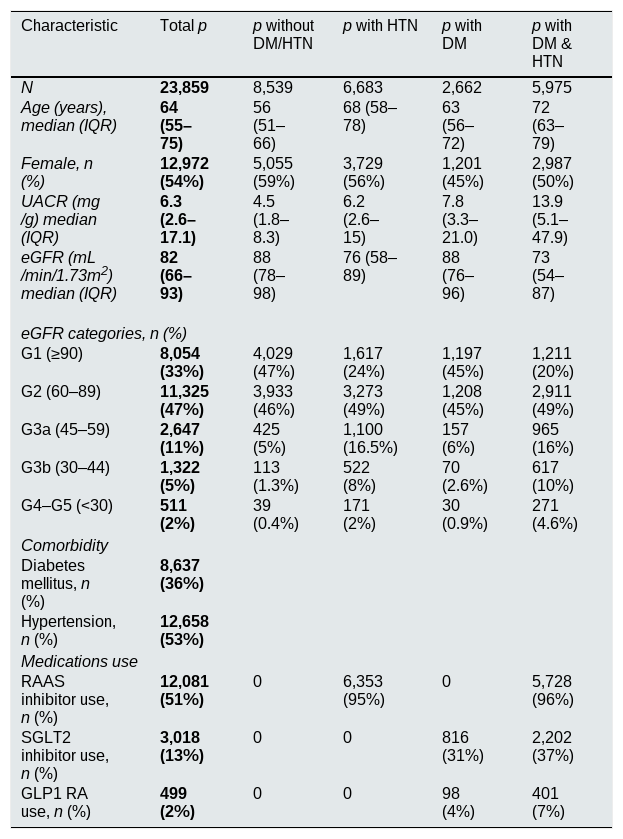
The baseline characteristics of the study participants are presented in Table 1. The median age of the participants was 64 years (IQR 55–75], and 54% (n=12,972) were female.
Baseline characteristics of the study population (N=23,859).
| Characteristic | Total p | p without DM/HTN | p with HTN | p with DM | p with DM & HTN |
|---|---|---|---|---|---|
| N | 23,859 | 8,539 | 6,683 | 2,662 | 5,975 |
| Age (years), median (IQR) | 64 (55–75) | 56 (51–66) | 68 (58–78) | 63 (56–72) | 72 (63–79) |
| Female, n (%) | 12,972 (54%) | 5,055 (59%) | 3,729 (56%) | 1,201 (45%) | 2,987 (50%) |
| UACR (mg/g) median (IQR) | 6.3 (2.6–17.1) | 4.5 (1.8–8.3) | 6.2 (2.6–15) | 7.8 (3.3–21.0) | 13.9 (5.1–47.9) |
| eGFR (mL/min/1.73m2) median (IQR) | 82 (66–93) | 88 (78–98) | 76 (58–89) | 88 (76–96) | 73 (54–87) |
| eGFR categories, n (%) | |||||
| G1 (≥90) | 8,054 (33%) | 4,029 (47%) | 1,617 (24%) | 1,197 (45%) | 1,211 (20%) |
| G2 (60–89) | 11,325 (47%) | 3,933 (46%) | 3,273 (49%) | 1,208 (45%) | 2,911 (49%) |
| G3a (45–59) | 2,647 (11%) | 425 (5%) | 1,100 (16.5%) | 157 (6%) | 965 (16%) |
| G3b (30–44) | 1,322 (5%) | 113 (1.3%) | 522 (8%) | 70 (2.6%) | 617 (10%) |
| G4–G5 (<30) | 511 (2%) | 39 (0.4%) | 171 (2%) | 30 (0.9%) | 271 (4.6%) |
| Comorbidity | |||||
| Diabetes mellitus, n (%) | 8,637 (36%) | ||||
| Hypertension, n (%) | 12,658 (53%) | ||||
| Medications use | |||||
| RAAS inhibitor use, n (%) | 12,081 (51%) | 0 | 6,353 (95%) | 0 | 5,728 (96%) |
| SGLT2 inhibitor use, n (%) | 3,018 (13%) | 0 | 0 | 816 (31%) | 2,202 (37%) |
| GLP1 RA use, n (%) | 499 (2%) | 0 | 0 | 98 (4%) | 401 (7%) |
RAAS: renin–angiotensin aldosterone system; SGLT2: sodium-glucose co-transporter 2; GLP1 RA: glucagon-like peptide-1 receptor agonist; P: patients.
Among them 8637 have diabetes [48% female; median age 70 years (IQR 61–79)] and in the 12,658 have hypertension [53% female; median age 69 years (IQR 59–79)]. Only diabetes was present in 11% (n=2662) of the population, only hypertension in 28% (n=6683), 25% (n=5975) had both conditions, and 36% (n=8539) no conditions.
The median latest eGFR was 82 (IQR 66–93) mL/min/1.73m2. According to KDIGO eGFR categories: 33.8% (8054) of patients were in stage G1 (eGFR≥90), 47.4% (11,325) in stage G2 (eGFR 60–89), 11.1% (2647) in stage G3a (eGFR 45–59), 5.5% (1322) in stage G3b (eGFR 30–44), and 2.1% (511) in stage G4/G5 (eGFR<30).
83% of the paired eGFR-UACR determinations had been requested from primary care, while 17% from hospital care (40% from nephrology, 20% from internal medicine and 15% from endocrinology). Notably, only 48% of the eligible population had undergone UACR testing; this rate climbed to 94.5% among those with diabetes but fell to 63% in hypertension and just 32.8% in those without either diagnosis, highlighting missed opportunities for early detection. The median of each subject's last UACR measurement was 6.3mg/g (IQR 2.6–17.1).
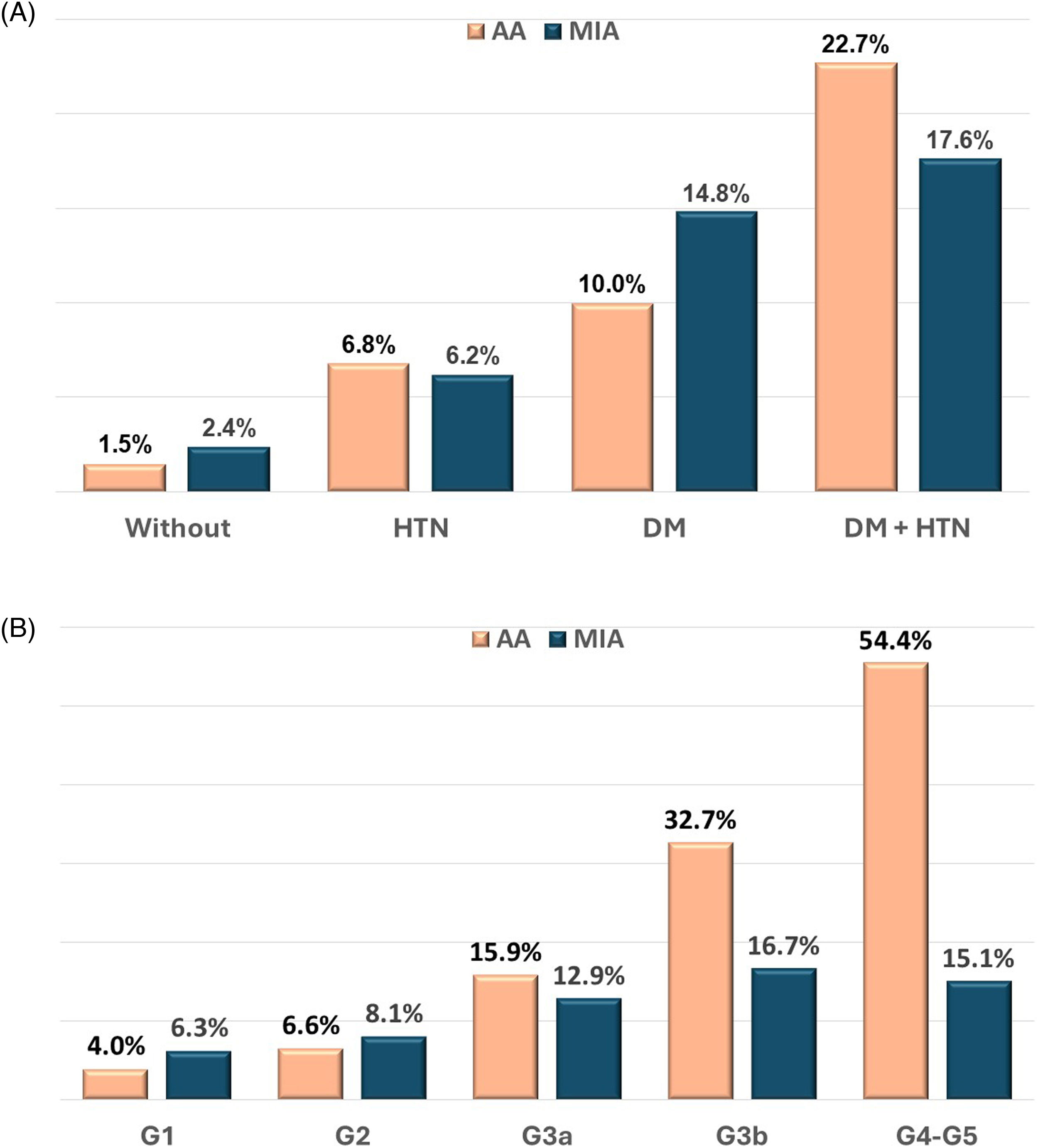
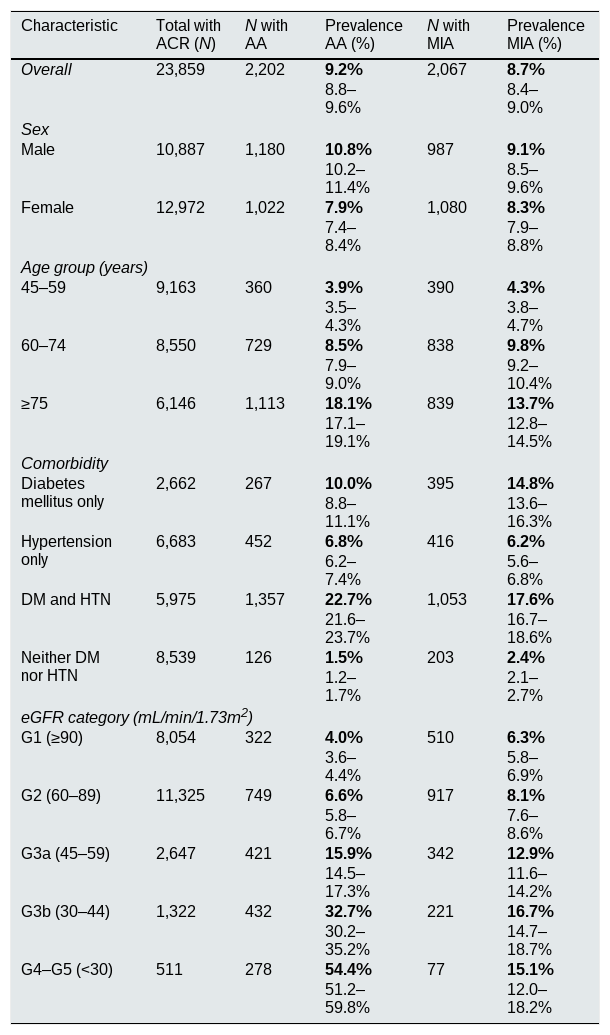
Prevalence and distribution of AAAbnormal albuminuria (AA, UACR≥30mg/g) was present in 9.2% (95% CI, 8.8–9.6), increasing with age (3.9% in 45–59y, 8.5% in 60–74y, and 18.1% in ≥75y). AA prevalence was higher in men (10.8%) than in women (7.9%). There was a step gradient by risk group: AA reached 18.8% in people with diabetes, 22.7% in those with both diabetes and hypertension, but remained as low as 1.5% in individuals with neither condition. An inverse association with kidney function was observed: 4.0% in G1, up to 54.4% in G4/G5 (Table 2, Fig. 1).
Prevalence of AA and MIA by sex, age group, comorbidity, and eGFR category.
| Characteristic | Total with ACR (N) | N with AA | Prevalence AA (%) | N with MIA | Prevalence MIA (%) |
|---|---|---|---|---|---|
| Overall | 23,859 | 2,202 | 9.2% | 2,067 | 8.7% |
| 8.8–9.6% | 8.4–9.0% | ||||
| Sex | |||||
| Male | 10,887 | 1,180 | 10.8% | 987 | 9.1% |
| 10.2–11.4% | 8.5–9.6% | ||||
| Female | 12,972 | 1,022 | 7.9% | 1,080 | 8.3% |
| 7.4–8.4% | 7.9–8.8% | ||||
| Age group (years) | |||||
| 45–59 | 9,163 | 360 | 3.9% | 390 | 4.3% |
| 3.5–4.3% | 3.8–4.7% | ||||
| 60–74 | 8,550 | 729 | 8.5% | 838 | 9.8% |
| 7.9–9.0% | 9.2–10.4% | ||||
| ≥75 | 6,146 | 1,113 | 18.1% | 839 | 13.7% |
| 17.1–19.1% | 12.8–14.5% | ||||
| Comorbidity | |||||
| Diabetes mellitus only | 2,662 | 267 | 10.0% | 395 | 14.8% |
| 8.8–11.1% | 13.6–16.3% | ||||
| Hypertension only | 6,683 | 452 | 6.8% | 416 | 6.2% |
| 6.2–7.4% | 5.6–6.8% | ||||
| DM and HTN | 5,975 | 1,357 | 22.7% | 1,053 | 17.6% |
| 21.6–23.7% | 16.7–18.6% | ||||
| Neither DM nor HTN | 8,539 | 126 | 1.5% | 203 | 2.4% |
| 1.2–1.7% | 2.1–2.7% | ||||
| eGFR category (mL/min/1.73m2) | |||||
| G1 (≥90) | 8,054 | 322 | 4.0% | 510 | 6.3% |
| 3.6–4.4% | 5.8–6.9% | ||||
| G2 (60–89) | 11,325 | 749 | 6.6% | 917 | 8.1% |
| 5.8–6.7% | 7.6–8.6% | ||||
| G3a (45–59) | 2,647 | 421 | 15.9% | 342 | 12.9% |
| 14.5–17.3% | 11.6–14.2% | ||||
| G3b (30–44) | 1,322 | 432 | 32.7% | 221 | 16.7% |
| 30.2–35.2% | 14.7–18.7% | ||||
| G4–G5 (<30) | 511 | 278 | 54.4% | 77 | 15.1% |
| 51.2–59.8% | 12.0–18.2% | ||||
CI: confidence interval; DM: diabetes mellitus; HTN: hypertension; eGFR: estimated glomerular filtration rate; CKD: chronic kidney disease; UACR: urinary albumin-to-creatinine ratio; AA: abnormal albuminuria; MIA: mildly increased albuminuria.
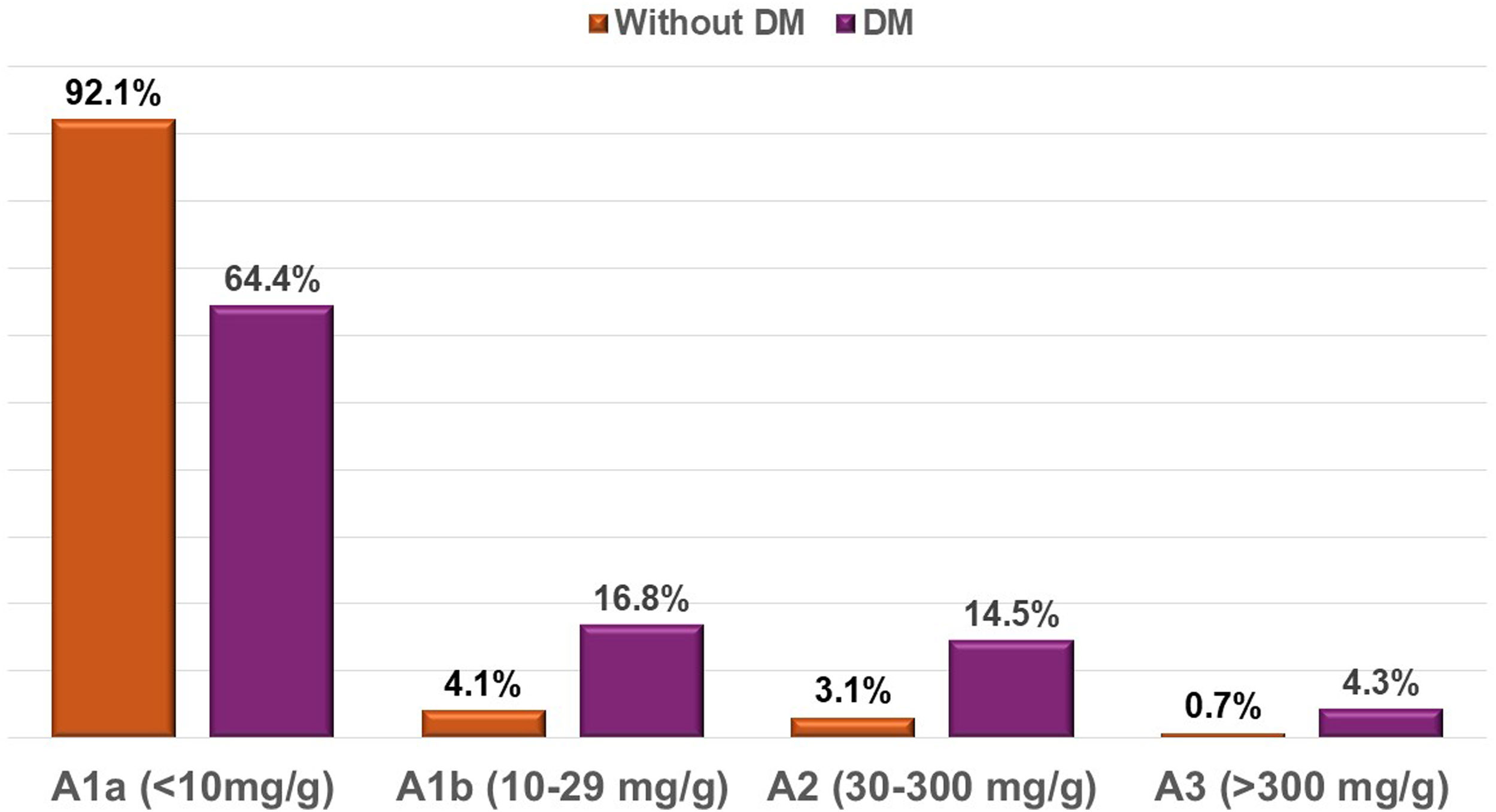
Distribution of KDIGO albuminuria categories according to diabetes status. Bars show the proportion of participants within each albuminuria category—A1a (normoalbuminuria, UACR<10mg/g), A1b/MIA (mildly increased albuminuria, UACR 10–29mg/g), A2 (moderately increased albuminuria, UACR 30–300mg/g), and A3 (severely increased albuminuria, UACR≥300mg/g)—stratified by the presence (DM) or absence (Without DM) of diabetes. DM: diabetes mellitus; MIA: mildly increased albuminuria; UACR: urinary albumin-to-creatinine ratio.
The distribution by KDIGO albuminuria categories was as follows: A1 (Normal to mildly increased, ACR<30mg/g): 90.8%. A2 (Moderately increased, ACR 30–299mg/g): 7.2% (n=1718). A3 (Severely increased, ACR≥300mg/g): 2.0% (n=484) (Fig. 1).
Prevalence and distribution of MIAMildly increased albuminuria (MIA, 10–29mg/g) was almost as frequent, observed in 8.7% (95% CI 8.4–9.0) (Table 2, Fig. 2). MIA prevalence was also higher in men (9.1%) and those ≥75y (13.7%), and in diabetes (16.8%) or with both risk factors (17.6%). An interesting pattern emerged in MIA prevalence across eGFR categories, MIA peaked at eGFR 30–44mL/min/1.73m2 (16.7%), declining at very low eGFR.
Prevalence of abnormal albuminuria (AA) and mildly increased albuminuria (MIA) by comorbidity and kidney function. (A) Prevalence of AA (UACR≥30mg/g) and MIA (UACR 10–29mg/g) according to the presence of hypertension (HTN), diabetes mellitus (DM), both conditions (DM+HTN), or neither. (B) Prevalence of AA and MIA according to eGFR category (KDIGO stages G1–G4/G5), based on each participant's most recent eGFR determination. AA: abnormal albuminuria; DM: diabetes mellitus; eGFR: estimated glomerular filtration rate; HTN: hypertension; MIA: mildly increased albuminuria.
In the bivariate analysis, older age, male sex, presence of diabetes (Fig. 1), and lower eGFR, were significantly associated with the presence of AA (all p<0.001). Similar associations were observed for MIA compared to “strict” normoalbuminuria (A1a: UACR<10mg/g).
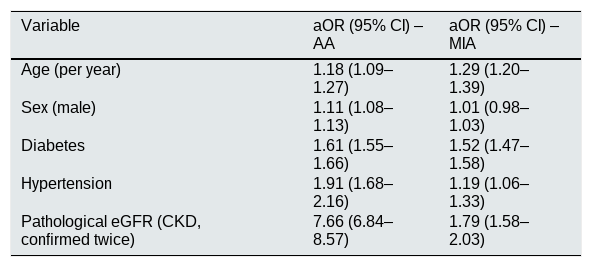
In the multivariable models, older age, diabetes, hypertension, and pathological eGFR (confirmed on two occasions) were independent predictors of both AA and MIA, with impaired kidney function showing the strongest association in both models (Table 3). Male sex was independently associated with AA (aOR 1.11, 95% CI 1.08–1.13) but not with MIA (aOR 1.01, 95% CI 0.98–1.03; p=0.617), suggesting that MIA is not simply a milder expression of the same risk process as AA. Accordingly, the AA model explained a substantially greater proportion of the outcome's variance than the MIA model (Nagelkerke R2 0.300 vs 0.108), indicating that these classical risk factors are less deterministic for MIA than for AA (Table 3).
Multivariable logistic regression models for AA and MIA.
| Variable | aOR (95% CI) – AA | aOR (95% CI) – MIA |
|---|---|---|
| Age (per year) | 1.18 (1.09–1.27) | 1.29 (1.20–1.39) |
| Sex (male) | 1.11 (1.08–1.13) | 1.01 (0.98–1.03) |
| Diabetes | 1.61 (1.55–1.66) | 1.52 (1.47–1.58) |
| Hypertension | 1.91 (1.68–2.16) | 1.19 (1.06–1.33) |
| Pathological eGFR (CKD, confirmed twice) | 7.66 (6.84–8.57) | 1.79 (1.58–2.03) |
AA model: χ2=3538.1, df=5, p<0.0001; Nagelkerke R2=0.300; Hosmer–Lemeshow χ2=82.16, df=8, p<0.0001.
MIA model: χ2=1106.97, df=5, p<0.0001; Nagelkerke R2=0.108; Hosmer–Lemeshow χ2=144.94, df=8, p<0.0001.
aOR: adjusted odds ratio (reference: no diabetes/no hypertension/eGFR≥60 confirmed on a single occasion, as applicable); CI: confidence interval; CKD: chronic kidney disease.
This large, population-based study provides robust evidence of the considerable burden of abnormal albuminuria (AA) and specifically mildly increased albuminuria (MIA) in a Mediterranean primary care population aged 45 years and older. We found that nearly one in five adults presented either AA (9.2%) or MIA (8.7%), reinforcing the clinical and epidemiological importance of early albuminuria detection.
Our findings confirm and extend prior research demonstrating a strong association of albuminuria with established risk factors such as advancing age, male sex, diabetes, hypertension, and declining eGFR. Notably, the co-presence of diabetes and hypertension was associated with the highest prevalences of AA and MIA, data consistent with the international cohorts including NHANES and meta-analyses showing multiplicative risks for renal and cardiovascular outcomes in these groups.1,3,6,9,11,13,24,25
The overall prevalence of AA (9.2%) in our cohort is slightly higher than that reported in other major Spanish primary care studies, such as EPIRCE (4.9%),26 IBERICAN (5.8%),20 SIMETAP (7.6%)21 and significantly lower than the results of the ONDAAS study (14.0%).27 This difference may be attributable to our methodology, which confirmed AA with two separate measurements, potentially providing a more accurate estimate of persistent albuminuria, as well as the slightly older median age of our cohort (64 years), older than the rest of the studies. However, our results are remarkably consistent with international data. For instance, the distribution of moderately increased (7.2%) and severely increased albuminuria (2.0%) closely mirrors the findings from the NHANES survey in the United States (7.5% and 2.1%, respectively), suggesting our findings are robust and generalizable.
The identification and detailed classification of MIA as a distinct category adds clinical significance to our study. Recent literature increasingly recognizes MIA as a meaningful risk marker (often overlooked in routine clinical practice) that predicts both chronic kidney disease progression and cardiovascular morbidity.7–12 Our data underscore a substantial “blind spot” in current screening paradigms where albuminuria thresholds ≥30mg/g predominate, potentially missing a significant proportion of at-risk individuals.28 The prevalence of MIA close to 10% in this cohort suggests that systematic inclusion of this category in primary care risk assessment could expand early intervention opportunities.29
An interesting point of divergence is this prevalence of MIA, which in our cohort was 8.7%, substantially lower than the 18.2% reported by the NHANES survey.14 This difference may, in part, also be methodological. Our study defined and confirmed MIA based on at least two separate measurements to ensure persistence. Alternatively, this could reflect true epidemiological differences between European and North American populations, possibly influenced by factors such as the prevalence of obesity, dietary habits, or genetic predispositions. Further research, including prospective studies that correlate albuminuria levels with risk factors like obesity and track long-term outcomes, will be necessary to fully elucidate these differing trends.
As expected, the prevalence was strongly stratified by the presence of comorbidities, rising from 1.5% for AA and 2.4% for MIA in individuals with neither diabetes nor hypertension to a striking 22.7% in AA and 17.6% in MIA in those with both conditions. This steep gradient underscores the synergistic impact of these risk factors on kidney damage and aligns with established evidence.30
A deeper analysis of these comorbidities reveals the profound and disproportionate impact of diabetes (Fig. 1). Individuals with diabetes had a fivefold AA prevalence (18.8 vs 3.8), significantly higher than those found with hypertension (14.2 vs 3.5). This demonstrates that, while both are major risk factors, diabetes confers a substantially greater independent risk for glomerular damage. When both conditions are present, the prevalence skyrockets to one in five people, illustrating a synergistic and deleterious effect. This finding reinforces that while hypertension is a key target for screening, the presence of diabetes, even normotensive diabetes, should trigger the highest level of vigilance and is the single most powerful clinical predictor of albuminuria in our population.
A subgroup deserving particular attention is that in stage G2, both for its frequency, almost half of the studied population, and because it presents a high combined rate of AA and MIA, one in six or seven people, and for being an important part of the recent controversies surrounding early diagnosis.28,31
Despite this, we identified a marked gap in albuminuria screening. Although screening rates were commendably high among patients with diabetes (94.5%), only 63% of hypertensive patients and 32.8% of individuals without these diagnoses underwent UACR measurement. This discrepancy highlights missed opportunities for early CKD and cardiovascular risk identification outside the diabetic population, a finding consistent with reports across healthcare systems worldwide.9–11 Enhancing screening coverage particularly in hypertensive patients and the ageing general population should be prioritized to optimize preventive strategies.
In this sense, our overall UACR screening rates exceed many published figures from North America and Europe, reflecting relative success in this Mediterranean setting. For example, by the meta-analysis of the Chronic Kidney Disease Prognosis Consortium31: their UACR screening rate was 35.1% (12.3%–74.5%) for diabetes and 4.1% (1.3%–20.7%) for hypertension. While in a recent review of patients with diabetes and/or hypertension from NHANES and the EHR from 2007–2018, the screening rate barely reached 17.5%.15 In Spain, Mata et al. described the determination of albuminuria in 62% of patients with type 2 DM studied.32
Nonetheless, the persisting screening gaps call for policy development, clinical education, and integration of electronic health record prompts to standardize albuminuria testing, including MIA, as part of routine care for cardiovascular risk groups.29,33
Even so, the overall completion rate of 48% across the entire eligible population implies that screening is very infrequent in patients without a diagnosis of diabetes or hypertension (one in three), but over 45 years old, age alone would be a risk factor, even with the presence of MIA.10 This represents a significant gap in care, as it misses the opportunity for early detection of CKD from other aetiologies or in patients with yet-undiagnosed metabolic conditions. This finding empirically supports calls from international guidelines to improve the early identification of CKD in primary care18 and perpetuates the debate on the recommendation of universal screening for albuminuria.34,35
Strengths of our study include its large, real-world population sample with comprehensive stratification and confirmation of albuminuria presence by at least two UACR measurements, enhancing diagnostic accuracy and thereby limiting misclassification due to transient albuminuria. The granularity offered by adopting the KDIGO 2024 classification with sub-stratification of normoalbuminuria into <10mg/g and MIA (10–29mg/g) provides refined risk stratification and clinical relevance.
Nevertheless, some limitations must be acknowledged. First, our study's cross-sectional design limits causal inference and temporal interpretation of albuminuria progression. Second, our reliance on retrospective EHR data may be subject to potential coding inaccuracies or missing information, although the diagnostic criteria used were standardized. Third, a potential selection bias exists, as the prevalence was calculated among individuals who were tested, which may not perfectly represent the entire population; since testing is more frequent among patients perceived as higher-risk by their clinicians, the prevalence estimates reported here likely represent an upper bound relative to the true prevalence in the full ≥45-year population, particularly for the group without diabetes or hypertension, where testing coverage was lowest (32.8%). Lastly, we lack granular data on ethnicity, obesity, smoking status, prior cardiovascular disease, and socioeconomic level, all of which may influence albuminuria prevalence and risk; these variables are not part of standard laboratory requests and are often not systematically documented in the electronic health record either, so their absence was an anticipated consequence of choosing a retrospective design based fundamentally on clinical laboratory data.
Moreover, although the study area presents a typical Mediterranean population with a high burden of cardiometabolic risk factors, extrapolation to other ethnic or geographic populations should be done cautiously. Future prospective studies correlating MIA with hard outcomes (cardiovascular events, CKD progression) in southern European populations would further elucidate the prognostic value and clinical benefits of expanded albuminuria screening.
In conclusion, abnormal and mildly increased albuminuria affect nearly one in five adults aged 45 and over in Mediterranean primary care. While albuminuria screening is effectively implemented in patients with diabetes, a considerable gap remains for patients with hypertension and for the general population without these conditions. Therefore, given its strong associations with diabetes, hypertension, age, and declining kidney function, systematic UACR screening, including for MIA, should be prioritized—at least within recognized risk groups such as hypertensive and older adults—to enable early detection and intervention and reduce the burden of CKD and cardiovascular events; however, formal cost-effectiveness and prospective outcome studies are still needed before universal population-wide screening can be recommended, given the ongoing debate on this issue.34
ORCID IDJosé Escribano-Serrano – 0000-0002-1047-7879
Enrique Jiménez-Varo – 0000-0002-1187-1157
María Escribano-Cobalea – 0000-0001-6065-5146
Antonio Hormigo-Pozo – 0000-0001-7558-5902
Data availability statement, scientific dataConflict of interestThe authors declared no conflicts of interest except for AMD who reports payments for lectures and presentations with Novo Nordisk and Lilly unrelated to this article.
We want to thank Dr. Pablo Gómez Fernández for his suggestions, teachings, support, and friendship throughout all these years.