



Loop diuretics are essential for managing fluid overload in heart failure (HF). However, diuretic resistance is a common problem that may compromise prognosis. Peritoneal ultrafiltration (PUF) has been used to address refractory congestion. This study aims to evaluate the efficacy of PUF in patients with refractory HF.
MethodsRetrospective, single-center study, conducted between April 2016 and August 2024, with follow-up until January 2025, including patients with NYHA class III–IV HF, resistant to diuretics, and without other criteria for initiating peritoneal dialysis. Clinical and laboratory parameters were analyzed before and after technique initiation.
ResultsFifteen patients were included (mean age 65.6±11.5 years, 80% male). The most frequent HF etiology was ischemic (47%), followed by valvular (20%). During a median follow-up of 23.5 months (IQR 9.3–43.8), median hospitalization days decreased from 10 to 0 days/year (p=0.012). NT-proBNP decreased from 9076 (IQR 6124–35,000) to 6126 (IQR 3371–16,561)pg/mL (n=14, p=0.004). Mean daily peritoneal ultrafiltration was 985±176mL, and residual diuresis increased from 873 to 1073mL/24h (p=0.001). Median furosemide-equivalent dose fell from 240 to 80mg/day (p<0.001). The proportion of patients on RAAS inhibitors increased from 27% to 67% (p=0.031), SGLT2 inhibitors from 40% to 67%, beta-blockers from 53% to 60%, and mineralocorticoid receptor antagonists from 20% to 53%. Seven peritonitis episodes occurred in seven patients (47%), a rate of 0.20 episodes per patient-year. Mortality was 67% (10/15), with cumulative survival of 76.4% at 12 months and 59.4% at 24 months.
ConclusionsPUF may represent an important therapeutic option in diuretic-resistant HF. Despite the small sample size and retrospective design, these findings suggest PUF could be a valuable approach in managing refractory heart failure with cardiorenal syndrome.
Los diuréticos de asa son esenciales para el manejo de la sobrecarga hídrica en la insuficiencia cardíaca (IC). Sin embargo, la resistencia a diuréticos es un problema frecuente que puede comprometer el pronóstico. La ultrafiltración peritoneal (UFP) se ha utilizado para abordar la congestión refractaria. Este estudio tiene como objetivo evaluar la eficacia de la UFP en pacientes con IC refractaria.
MétodosEstudio retrospectivo, unicéntrico, realizado entre abril de 2016 y agosto de 2024, con seguimiento hasta enero de 2025, que incluyó pacientes con IC en clase funcional III-IV de la NYHA, resistentes a diuréticos, y sin otros criterios para iniciar diálisis peritoneal. Se analizaron parámetros clínicos y de laboratorio antes y después del inicio de la técnica.
ResultadosSe incluyeron quince pacientes (edad media 65,6± 11,5 años, 80% varones). La etiología más frecuente de la IC fue la isquémica (47%), seguida de la valvular (20%). Durante una mediana de seguimiento de 23,5 meses (IQR 9,3–43,8), la mediana de días de hospitalización disminuyó de 10 a 0 días/año (p=0,012). El NT-proBNP descendió de 9076 (IQR 6124–35000) a 6126 (IQR 3371–16561) pg/ml (n=14, p=0,004). La ultrafiltración peritoneal diaria media fue de 985±176ml y la diuresis residual aumentó de 873 a 1073ml/24h (p=0,001). La mediana de la dosis equivalente de furosemida disminuyó de 240 a 80mg/día (p<0,001). La proporción de pacientes con inhibidores del SRAA aumentó del 27% al 67% (p=0,031), con iSGLT2 del 40% al 67%, con betabloqueantes del 53% al 60% y con antagonistas del receptor mineralocorticoideo del 20% al 53%. Se registraron siete episodios de peritonitis en siete pacientes (47%), lo que supone una tasa de 0,20 episodios por paciente-año. La mortalidad fue del 67% (10/15), con una supervivencia acumulada del 76,4% a los 12 meses y del 59,4% a los 24 meses.
ConclusionesLa UFP puede representar una opción terapéutica importante en la IC resistente a diuréticos. A pesar del tamaño muestral reducido y del diseño retrospectivo, estos hallazgos sugieren que la UFP podría constituir un abordaje valioso en el manejo de la IC refractaria con síndrome cardiorrenal.
Heart failure (HF) represents a major public health problem, with high prevalence and associated costs, especially due to recurrent hospitalizations.1 Acute HF decompensation predominantly manifests with signs and symptoms of venous congestion, which are major predictors of poor prognosis.2,3
Loop diuretics remain the cornerstone of fluid overload treatment, both in acute management and chronic stabilization of HF.4 However, diminished diuretic response is a frequent problem, affecting the patient's clinical course and leading to hospitalizations and morbidity.5
Diuretic resistance is defined as the inability to achieve decongestion despite adequate and escalating loop diuretic therapy.6 The pathophysiology of diuretic resistance is complex and multifactorial, involving pharmacokinetic and pharmacodynamic alterations. Decreased cardiac output, increased central venous pressure, and neurohormonal activation contribute to reduced renal perfusion and, consequently, to diminished diuretic response.7,8
When medical therapy becomes ineffective in controlling congestion, mechanical fluid removal methods may need to be considered. Extracorporeal ultrafiltration has been studied, but results are inconsistent and the technique requires vascular access and hospital admission.9–11 Peritoneal ultrafiltration (PUF)—the use of peritoneal dialysis (PD) with the primary purpose of fluid removal rather than solute clearance—emerges as a home-based therapeutic alternative, allowing continuous and slow fluid removal, with hemodynamic stability and preservation of residual renal function.12,13 Observational studies have demonstrated promising results in terms of reduced hospitalizations, improved functional class, and quality of life.14–16
This study aims to evaluate the efficacy and safety of PUF in patients with diuretic-resistant HF in a Portuguese population.
MethodsStudy design and populationRetrospective, observational, single-center study including all patients who initiated PUF for diuretic-resistant HF between April 2016 and August 2024, with follow-up until January 2025. Adult patients (≥18 years) with New York Heart Association (NYHA) class III–IV HF, resistant to diuretics despite optimized therapy, and without other indications for PD were included.
Diuretic resistance was defined, in accordance with the Heart Failure Association position statement on the use of diuretics,4 as the persistence of signs and symptoms of congestion despite a daily oral furosemide-equivalent dose ≥240mg, together with a spot urinary sodium concentration<50mEq/L measured two hours after diuretic administration.6
Patients were excluded if they had end-stage renal disease, contraindications to peritoneal catheter placement, or a life expectancy of less than 6 months due to other comorbidities. End-stage renal disease was defined as an estimated glomerular filtration rate (eGFR)<15mL/min/1.73m2 accompanied by uremic symptoms, refractory hyperkalemia or metabolic acidosis—that is, patients meeting conventional criteria for initiation of kidney replacement therapy for indications other than volume overload. Contraindications to catheter placement were extensive previous abdominal surgery with documented adhesions, uncorrected abdominal wall or inguinal hernia, active intra-abdominal infection, ostomies, and inability to perform exchanges in the absence of a trained caregiver.
Residual diuresis was defined as the 24-h urine volume recorded at PUF initiation. Major adverse cardiovascular events (MACE) were defined as the composite of cardiovascular death, non-fatal acute coronary syndrome, non-fatal stroke, sustained ventricular arrhythmia or arrhythmia requiring hospitalization, and unplanned hospitalization for worsening HF. Technique-related complications comprised peritonitis (diagnosed according to International Society for Peritoneal Dialysis criteria17), exit-site and tunnel infection, catheter malfunction or migration requiring intervention, dialysate leak, new or worsening abdominal wall hernia, hydrothorax, and PD-related hypoalbuminemia.
The study was designed, conducted and reported in accordance with the STROBE (Strengthening the Reporting of Observational Studies in Epidemiology) statement for cohort studies18; the completed checklist is provided as Supplementary Material.
Peritoneal ultrafiltration protocolPeritoneal Tenckhoff catheters were placed laparoscopically under general anesthesia, and PUF was initiated after a break-in period of approximately three weeks. Exchanges were performed independently by 13 patients (87%); the remaining required assistance from a trained caregiver.
All patients started on continuous ambulatory peritoneal dialysis with one or two daily manual exchanges of 7.5% icodextrin over a long dwell of 10–12h, with a fill volume adjusted to height (1500–2000mL). Icodextrin was selected as the first-line solution because of its sustained ultrafiltration profile during long dwells and its lower glucose load.19 A daytime exchange with 1.36% or 2.27% dextrose was added in cases of congestion recurrence—defined as body-weight gain>2kg over one week, worsening peripheral edema or orthopnea, or an unscheduled need for intravenous diuretics—or of declining solute clearance.
All patients received individualized dietary counseling from a renal dietitian, comprising sodium restriction (<5g of salt, equivalent to <2g of sodium, per day), fluid restriction to 1.5L/day adjusted to residual diuresis and daily ultrafiltration, and a protein intake of 1.0–1.2g/kg/day to offset peritoneal protein losses. Patients were instructed to record body weight daily at home and to contact the unit if weight increased by more than 2kg over 48–72h.
Optimized pharmacological therapy for HF was maintained according to tolerance, including renin–angiotensin–aldosterone system (RAAS) inhibitors, beta-blockers, mineralocorticoid receptor antagonists, and sodium-glucose cotransporter 2 inhibitors (SGLT2i), in accordance with international guideline recommendations.20
Data collection and endpointsDemographic, clinical and laboratory data were retrieved from electronic medical records. Baseline variables included age, sex, comorbidities, HF etiology, NYHA class, left ventricular ejection fraction, body weight, blood pressure, furosemide-equivalent dose and residual diuresis. eGFR was calculated using the 2009 CKD-EPI creatinine equation.21 NT-proBNP was measured with an assay with an upper limit of quantification of 35,000pg/mL; values exceeding this threshold were recorded as 35,000pg/mL.
Follow-up variables—NT-proBNP, peritoneal ultrafiltration volume, residual diuresis, guideline-directed medical therapy and furosemide-equivalent dose—were recorded 6 months after PUF initiation, or at the last available assessment for patients with shorter follow-up. Peritonitis episodes, technique-related complications, MACE, technique discontinuation and death were recorded throughout follow-up.
The primary endpoint was the reduction in hospitalization days for decompensated HF, compared between the 12 months preceding and the 12 months following PUF initiation. For patients who died or discontinued PUF before completing 12 months of follow-up, hospitalization days were annualized according to time at risk (hospitalization days÷follow-up days×365). Secondary endpoints were the change in NT-proBNP, peritoneal ultrafiltration volume and residual diuresis, changes in guideline-directed medical therapy and loop diuretic requirements, MACE, technique-related complications and mortality.
Statistical analysisStatistical analysis was performed using SPSS version 25.0 (IBM SPSS Statistics, Armonk, NY, USA). Normality of continuous variables was assessed with the Shapiro–Wilk test. Continuous variables are expressed as mean±standard deviation (SD) or median (interquartile range, IQR) according to distribution. Categorical variables are presented as absolute frequencies and percentages. Paired comparisons between the pre- and post-PUF periods were performed with the paired t-test for normally distributed variables and the Wilcoxon signed-rank test otherwise; paired categorical variables, including the proportion of patients on each class of prognostic medication before and after PUF initiation, were compared with the McNemar test. Effect sizes for non-parametric paired comparisons are reported as r=Z/√N. Survival was analyzed by the Kaplan–Meier method. A two-sided p-value<0.05 was considered statistically significant; estimates are reported with 95% confidence intervals (CI).
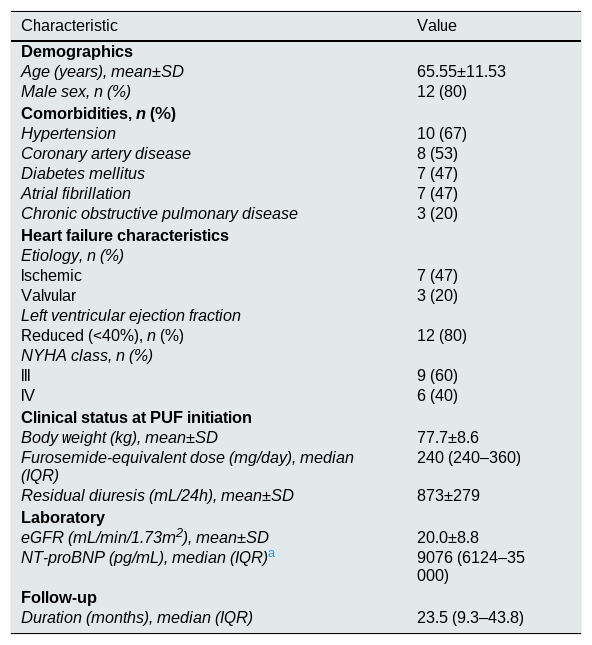
ResultsBaseline population characteristicsFifteen patients were included, with a mean age of 65.6±11.5 years; 12 (80%) were male. The most prevalent comorbidities were hypertension (67%), coronary artery disease (53%) and diabetes mellitus (47%). Nine patients (60%) were in NYHA class III and six (40%) in class IV at PUF initiation.
The most frequent HF etiology was ischemic (n=7, 47%), followed by valvular (n=3, 20%). The remaining cases comprised AL amyloidosis, TTR amyloidosis, arrhythmogenic right ventricular dysplasia, toxic etiology and idiopathic HF (n=1, 7% each). Twelve patients (80%) had reduced left ventricular ejection fraction (<40%), one had preserved left ventricular ejection fraction and two had predominantly right-sided HF.
At PUF initiation, mean eGFR was 20.0±8.8mL/min/1.73m2, reflecting moderate to severe renal dysfunction in the context of cardiorenal syndrome, and mean residual diuresis was 873±279mL/24h. Median follow-up was 23.5 months (IQR 9.3–43.8), corresponding to 34.3 patient-years. Baseline characteristics are summarized in Table 1.
Baseline population characteristics.
| Characteristic | Value |
|---|---|
| Demographics | |
| Age (years), mean±SD | 65.55±11.53 |
| Male sex, n (%) | 12 (80) |
| Comorbidities, n (%) | |
| Hypertension | 10 (67) |
| Coronary artery disease | 8 (53) |
| Diabetes mellitus | 7 (47) |
| Atrial fibrillation | 7 (47) |
| Chronic obstructive pulmonary disease | 3 (20) |
| Heart failure characteristics | |
| Etiology, n (%) | |
| Ischemic | 7 (47) |
| Valvular | 3 (20) |
| Left ventricular ejection fraction | |
| Reduced (<40%), n (%) | 12 (80) |
| NYHA class, n (%) | |
| III | 9 (60) |
| IV | 6 (40) |
| Clinical status at PUF initiation | |
| Body weight (kg), mean±SD | 77.7±8.6 |
| Furosemide-equivalent dose (mg/day), median (IQR) | 240 (240–360) |
| Residual diuresis (mL/24h), mean±SD | 873±279 |
| Laboratory | |
| eGFR (mL/min/1.73m2), mean±SD | 20.0±8.8 |
| NT-proBNP (pg/mL), median (IQR)a | 9076 (6124–35000) |
| Follow-up | |
| Duration (months), median (IQR) | 23.5 (9.3–43.8) |
Twelve patients (80%) required the addition of a daytime dextrose exchange during follow-up.
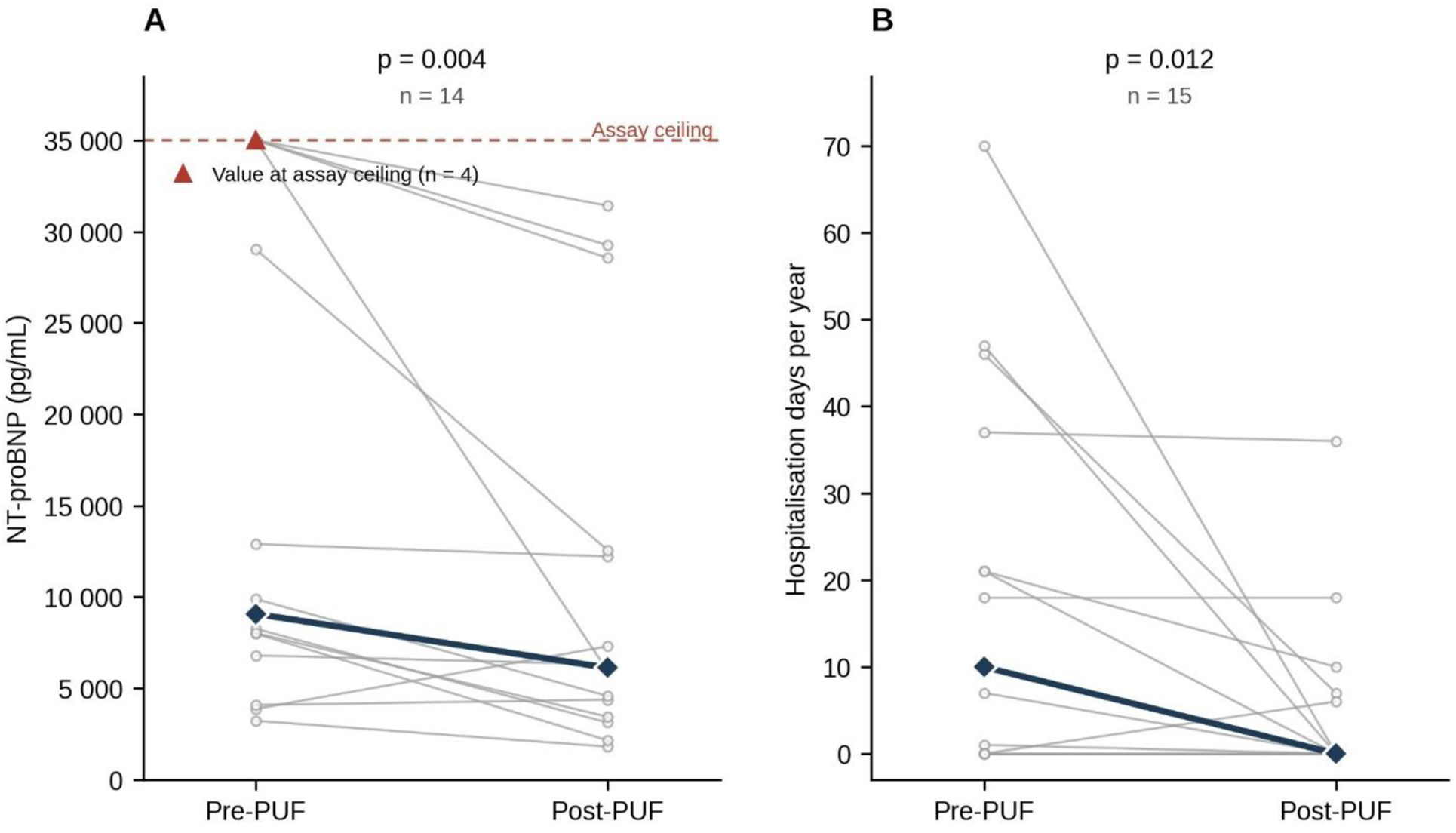
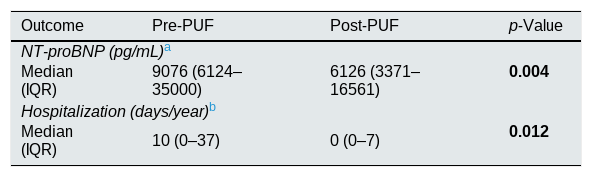
Impact on hospitalizationsMedian hospitalization days for decompensated HF decreased from 10 (IQR 0–37) to 0 (IQR 0–7) days per year (Z=−2.499, p=0.012, r=0.65), corresponding to a mean reduction from 18.5±22.0 to 5.1±10.0days/year. Nine patients (60%) reduced their hospitalization burden, five (33%) remained unchanged—four of whom had no admissions at baseline—and one (7%) increased. Individual trajectories are shown in Fig. 1.
Individual patient trajectories before and after PUF initiation. (A) NT-proBNP concentrations (n=14; one patient had no pre-PUF value available). Gray lines represent individual patients and the dark line connects median values. The dashed line indicates the upper limit of quantification of the assay (35,000pg/mL); red triangles mark the four patients whose pre-PUF concentration was at this ceiling and was recorded as 35,000pg/mL. No post-PUF value reached the ceiling. (B) Hospitalization days for decompensated heart failure in the year before and the year after PUF initiation (n=15). p values from Wilcoxon signed-rank tests.
NT-proBNP was available for 14 patients. Median values decreased from 9076 (IQR 6124–35,000) to 6126 (IQR 3371–16,561)pg/mL (Z=−2.919, p=0.004, r=0.78), a 33% median reduction, and 12 patients (86%) showed a decrease—Table 2. Four patients (29%) had a pre-PUF concentration at the assay ceiling, whereas no post-PUF value reached it; the observed reduction therefore represents a conservative estimate. Individual trajectories are shown in Fig. 1.
Clinical outcomes before and after PUF initiation.
| Outcome | Pre-PUF | Post-PUF | p-Value |
|---|---|---|---|
| NT-proBNP (pg/mL)a | |||
| Median (IQR) | 9076 (6124–35000) | 6126 (3371–16561) | 0.004 |
| Hospitalization (days/year)b | |||
| Median (IQR) | 10 (0–37) | 0 (0–7) | 0.012 |
Data are presented as median (interquartile range). Wilcoxon signed-rank test was used for paired comparisons.
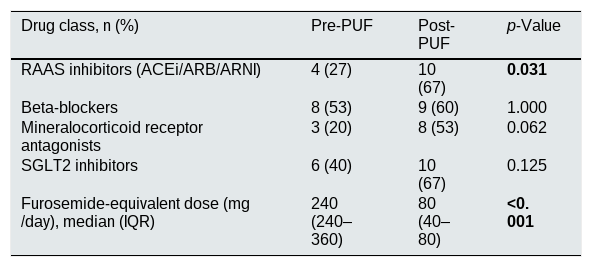
Median furosemide-equivalent dose decreased from 240mg/day (IQR 240–360) to 80mg/day (IQR 40–80) (Z=−3.426, p<0.001, r=0.88), a median reduction of 67% (range 50–100%). All 15 patients reduced their dose, seven (47%) were maintained on 40mg/day or less, and two (13%) discontinued loop diuretics entirely. The proportion of patients receiving guideline-directed medical therapy increased for all classes, reaching statistical significance only for RAAS inhibitors (Table 3).
Pharmacological therapy before and after PUF initiation.
| Drug class, n (%) | Pre-PUF | Post-PUF | p-Value |
|---|---|---|---|
| RAAS inhibitors (ACEi/ARB/ARNI) | 4 (27) | 10 (67) | 0.031 |
| Beta-blockers | 8 (53) | 9 (60) | 1.000 |
| Mineralocorticoid receptor antagonists | 3 (20) | 8 (53) | 0.062 |
| SGLT2 inhibitors | 6 (40) | 10 (67) | 0.125 |
| Furosemide-equivalent dose (mg/day), median (IQR) | 240 (240–360) | 80 (40–80) | <0.001 |
Data are presented as n (%) or median (interquartile range) for all 15 patients. Pre-PUF values refer to the treatment in place at the time of PUF initiation; post-PUF values refer to the treatment in place 6 months after PUF initiation, or at the last available assessment for patients with shorter follow-up. Categorical variables were compared with the McNemar test and furosemide-equivalent dose with the Wilcoxon signed-rank test.
ACEi, angiotensin-converting enzyme inhibitor; ARB, angiotensin receptor blocker; ARNI, angiotensin receptor–neprilysin inhibitor; IQR, interquartile range; PUF, peritoneal ultrafiltration; RAAS, renin–angiotensin–aldosterone system; SGLT2, sodium-glucose cotransporter 2.
During follow-up, seven peritonitis episodes occurred in seven patients (47%), a rate of 0.20 episodes/patient-year (7 episodes over 34.3 patient-years; 95% CI 0.08–0.42). All resolved with antibiotic therapy alone, and no catheter required removal. Catheter dysfunction occurred in three patients (20%), all managed conservatively with laxatives and flushing, without repositioning or replacement. No abdominal wall hernias, dialysate leaks or hydrothorax were recorded.
Six MACE occurred in four patients (27%): three fatal events (myocardial infarction, n=2; ischemic stroke, n=1) and three hospitalizations, for acute coronary syndrome, arrhythmia and worsening HF (n=1 each).
Eight patients (53%) discontinued PUF during follow-up. In three, the technique was withdrawn in the context of end-of-life care, and death occurred within two weeks. Two patients were transferred to hemodialysis because of progressive kidney disease with worsening solute clearance and congestion that could no longer be addressed by intensifying the peritoneal prescription. Two discontinued because of increasing dependency for activities of daily living, in the absence of a caregiver able to maintain the technique. One patient discontinued after 8.5 months following recovery of adequate diuresis and sustained decongestion, with eGFR rising from 16 to 21mL/min/1.73m2 and a residual diuresis of 1700mL/24h. All eight subsequently died, at a median of 4.1 months after discontinuation (range 0.4–14.6). Two further patients died while still on PUF, and the remaining five (33%) were alive and on the technique at the end of follow-up. No technique discontinuation was attributable to a mechanical or infectious complication.
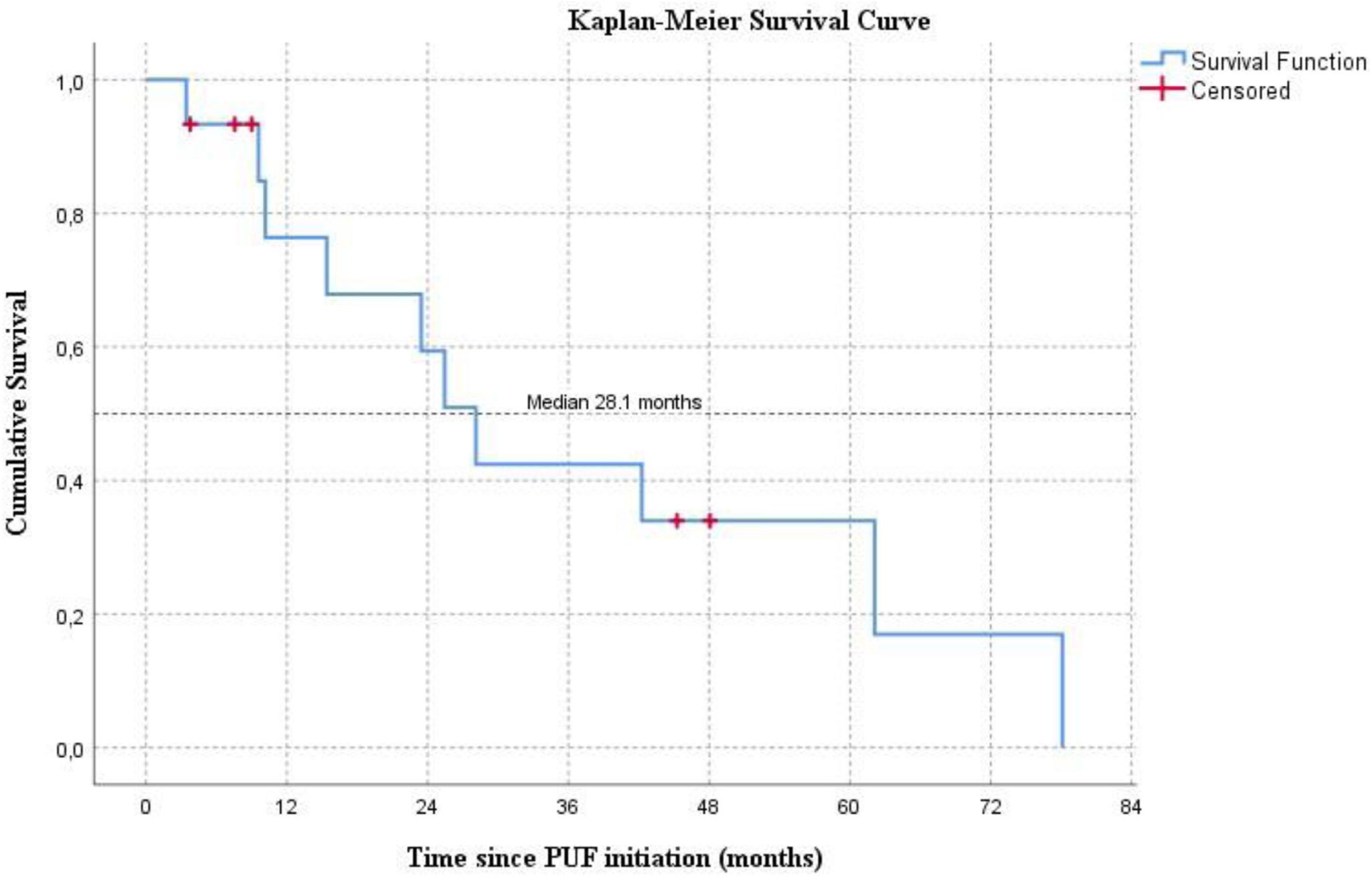
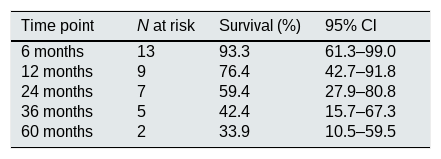
SurvivalTen deaths occurred over the study period (67% mortality), while five patients (33%) remained alive at the end of follow-up. Median survival was 28.1 months (95% CI 20.4–35.8). Cumulative survival was 93.3% at 6 months, 76.4% at 12 months, 59.4% at 24 months, 42.4% at 36 months and 33.9% at 60 months (Table 4). The Kaplan–Meier curve showed early mortality within the first year, followed by a more gradual decline thereafter (Fig. 2).
Cumulative survival rates at specific time points.
| Time point | N at risk | Survival (%) | 95% CI |
|---|---|---|---|
| 6 months | 13 | 93.3 | 61.3–99.0 |
| 12 months | 9 | 76.4 | 42.7–91.8 |
| 24 months | 7 | 59.4 | 27.9–80.8 |
| 36 months | 5 | 42.4 | 15.7–67.3 |
| 60 months | 2 | 33.9 | 10.5–59.5 |
Data derived from Kaplan–Meier survival analysis. Median survival was 28.1 months (95% CI: 20.4–35.8). N at risk indicates the number of patients still under observation at each time point. Confidence intervals for survival estimates were calculated using the complementary log–log transformation.
CI, confidence interval.
Kaplan–Meier survival curve. Kaplan–Meier survival curve for 15 patients with diuretic-resistant heart failure treated with peritoneal ultrafiltration. Median survival was 28.1 months (95% CI: 20.4–35.8). Vertical tick marks indicate censored cases (patients alive at the end of follow-up). Ten deaths (67%) occurred during a median follow-up of 23.5 months.
The leading cause of death was infection (n=7, 70%), arising from a skin and soft tissue source in four patients and a respiratory source in three. The remaining three deaths were cardiovascular—myocardial infarction in two patients and ischemic stroke in one—and are included among the MACE reported above. No death was attributed to peritonitis or to any other PD-related complication.
DiscussionOur findings support PUF as a potentially effective and safe therapeutic option in diuretic-resistant HF with cardiorenal syndrome, with significant reductions in hospitalizations for decompensated HF and in NT-proBNP concentrations, alongside an acceptable safety profile. The median reduction of 10 hospitalization days per patient-year represents a substantial clinical and economic benefit, although smaller in absolute terms than the approximately 35 days/patient-year reported in the meta-analysis by Timóteo et al.14 This difference is largely explained by a lower baseline hospitalization burden in our cohort: four of the 15 patients (27%) had no admissions in the year preceding PUF initiation and therefore had no margin for reduction, whereas published series have generally selected patients on the basis of recurrent admissions. In a post hoc analysis restricted to the 11 patients with at least one admission at baseline, median hospitalization days fell from 21 to 0 (p=0.004), a magnitude closer to that reported in pooled analyses. Definitions also differ across studies, with some counting only HF-related admissions and others all-cause admissions, which further limits direct comparison.
Biomarkers and congestionMean daily peritoneal ultrafiltration of 985mL is consistent with the sustained ultrafiltration profile expected from a single long icodextrin dwell19 and, combined with residual diuresis, corresponded to a total daily fluid removal of approximately 2.1L.
Three independent markers pointed consistently toward effective decongestion: NT-proBNP fell by 33%, residual diuresis rose by 23%, and the loop diuretic dose was reduced by 67%. NT-proBNP is an established prognostic biomarker in HF, and its reduction is associated with decreased mortality and readmissions22,23; the concurrent fall in biomarker concentration and in diuretic requirement therefore represents an objective, rather than merely symptomatic, improvement in congestion status.
The combination of increased urine output with a substantially lower diuretic dose is physiologically coherent. Continuous and gradual fluid removal by PUF preserves hemodynamic stability and renal perfusion and avoids the neurohormonal activation associated with high-dose diuretics,24 while decongestion lowers central venous pressure and intra-abdominal pressure, both of which impair renal perfusion in cardiorenal syndrome, thereby restoring intrinsic diuretic responsiveness.
Therapeutic optimizationThe most consistent change in medical therapy was a marked reduction in loop diuretic requirements, with a median dose decrease of 67% and complete discontinuation in two patients.
The proportion of patients on guideline-directed medical therapy also increased, although only the change in RAAS inhibitors reached statistical significance in this small cohort. The proportions achieved after PUF initiation are nonetheless higher than typically reported in advanced HF with renal dysfunction,25 plausibly explained by effective volume control avoiding the hypotension and renal function deterioration that frequently limit uptitration. The permanent peritoneal catheter additionally enables temporary intensification of home-based PUF during acute decompensations.
Safety and complicationsThe observed peritonitis rate of 0.20 episodes/patient-year remained below the International Society for Peritoneal Dialysis 2022 target of ≤0.40 episodes per patient-year at risk,17 and is consistent with the rates reported in international peritoneal dialysis registry data.26 This finding should nonetheless be interpreted with caution: seven of 15 patients (47%) experienced at least one episode, and the upper limit of the confidence interval reaches the recommended threshold, reflecting the limited exposure of 34.3 patient-years.
Mechanical complications were confined to catheter dysfunction in three patients, all resolved conservatively, and none contributed to technique discontinuation—in contrast with series in which catheter dysfunction accounts for a substantial proportion of technique failure. The absence of pressure-related complications may in part reflect the PUF prescription itself: one or two daily exchanges entail considerably lower cumulative intra-abdominal pressure exposure than conventional four-exchange continuous ambulatory peritoneal dialysis. Overall, these data suggest an acceptable safety profile in this population.
Mortality and survivalThe observed mortality of 67% is consistent with the severity of the study population, characterized by advanced heart failure with diuretic resistance and significant renal impairment. Studies in similar populations have reported comparable mortality rates of 50–70% over 2–3 years.1,8
Median survival of 28.1 months (95% CI 20.4–35.8) falls within the range reported in comparable populations. Previous systematic reviews and meta-analyses have described variable survival outcomes in similar cohorts,13,14 with median survival times ranging from 12 to 48 months.16,27,28 The relatively narrow confidence interval, despite the small sample size, suggests a reasonably precise estimate. In the absence of a control group these data cannot demonstrate a survival benefit attributable to PUF; previous studies suggest that PUF may not significantly modify survival but substantially improves quality of life and reduces hospitalizations.14,29
Pathophysiological mechanismsPUF may offer advantages over high-dose diuretics through several mechanisms. Unlike diuretics, which promote natriuresis disproportionate to aquaresis, PUF achieves isotonic fluid removal without activating the renin–angiotensin–aldosterone system or the sympathetic nervous system.29 This slow and continuous ultrafiltration maintains hemodynamic stability and preserves residual renal function.30 Additionally, by reducing intra-abdominal pressure, PUF may improve renal perfusion.31 Removal of inflammatory mediators and pro-inflammatory cytokines has also been described.32 Finally, PUF avoids the braking phenomenon associated with chronic diuretic use, in which compensatory sodium reabsorption occurs due to distal tubule remodeling.33
Compared with extracorporeal ultrafiltration, PUF provides continuous and gradual rather than intermittent and rapid fluid removal, avoids myocardial stunning,34 requires no vascular access, can be performed at home, and has substantially lower cost. These characteristics make PUF better suited to chronic management, whereas extracorporeal ultrafiltration remains an option for acute decompensation.
StrengthsThis study reports a consecutive, unselected cohort managed under a uniform protocol in a single center, which limits heterogeneity in prescription and follow-up. Outcome ascertainment was complete: no patient was lost to follow-up, and vital status was known for all 15 patients at study closure. The observation period of 34.3 patient-years, with a median follow-up of 23.5 months and a maximum of 78 months, is comparable to or longer than that of most published series in this indication. Causes of death, reasons for technique discontinuation and serial measurements of ultrafiltration volume, residual diuresis and diuretic dose were individually retrieved, allowing the effect of PUF to be characterized beyond hospitalization counts alone. The cohort is contemporary and spans the period of introduction of SGLT2 inhibitors and therefore reflects current heart failure management. Finally, the paired within-patient design, in which each patient serves as their own control, removes between-patient confounding, although it does not protect against regression to the mean.
LimitationsSeveral limitations should be acknowledged. This was a retrospective, single-center study of a small cohort, and the sample size limits the precision of all estimates, particularly survival at later time points. The absence of a control group precludes any causal inference regarding the effect of PUF on hospitalization or survival; recent systematic reviews have emphasized the need for randomized controlled trials to establish a survival benefit in this population.13–15 Because patients were selected for PUF on the basis of recurrent decompensations, the before-and-after comparison of hospitalization days is also susceptible to regression to the mean.
Retrospective ascertainment is likely to have underestimated non-infectious mechanical complications. Applying the published incidence rates of 0.08 hernias and 0.13 leaks per patient-year,35 approximately three hernias and four dialysate leaks would have been expected over 34.3 patient-years, whereas none were recorded; leaks in particular are under-reported even in prospective series, and minor pericatheter leaks managed by temporary reduction of fill volume may not have been documented.
Three variables of interest could not be analyzed. Home body weight monitoring was used for clinical management but was not systematically recorded in the clinical file, precluding a formal fluid balance calculation; decongestion was therefore assessed through peritoneal ultrafiltration volume, residual diuresis, NT-proBNP and loop diuretic requirements. Albuminuria was not systematically measured, despite its recognized prognostic value in cardiorenal syndrome. Quality of life was not assessed, as no structured instrument was applied during routine follow-up, which precludes evaluation of an outcome of particular relevance in a therapy with largely palliative intent.
ConclusionsIn this single-center cohort of patients with diuretic-resistant heart failure and cardiorenal syndrome, PUF was associated with significant reductions in hospitalization days, NT-proBNP concentrations and loop diuretic requirements, together with an increase in residual diuresis, and with a peritonitis rate below the ISPD recommended target. These findings are consistent with the existing observational evidence, but the retrospective design, the small sample size and the absence of a control group preclude causal inference. Multicenter randomized trials are needed to define the role of PUF in the therapeutic algorithm of advanced heart failure.
Learning points/Take home messages- 1.
Peritoneal ultrafiltration is an option worth considering in diuretic-resistant heart failure, with reductions in hospitalization days and NT-proBNP concentrations.
- 2.
Decongestion allows a marked reduction in loop diuretic requirements while residual diuresis increases, and may facilitate uptitration of guideline-directed medical therapy.
- 3.
The safety profile is acceptable, with a peritonitis rate below the ISPD recommended target of ≤0.40 episodes per patient-year and no technique discontinuation attributable to a mechanical or infectious complication.
- 4.
Close collaboration between Cardiology and Nephrology is essential for early identification and optimized management of these patients.
Inês Alexandre: 0009-0004-9482-3055
Maria Inês Gil Martins Roxo: 0000-0003-1512-8077
Ana Rita Pereirinha Ramos: 0009-0002-1931-028X
Gonçalo Rodrigues de Ávila: 0000-0002-4851-5842
Patrícia Moreira Matias: 0000-0003-4344-5555
Sofia Azeredo Pereira: 0000-0002-8456-9995
Patrícia Branco: 0000-0002-8563-834X
Rita Calça: 0000-0001-8960-2363
Ethical considerationsAll procedures were conducted in accordance with the Declaration of Helsinki. Informed consent was waived given the retrospective nature of the study and use of anonymised data.
Declaration of generative AI and AI-assisted technologies in the manuscript preparation processDuring the preparation of this work the author(s) used Claude by Anthropic for grammar and language editing assistance. After using this tool/service, the authors reviewed and edited the content as needed and take full responsibility for the content of the published article.
FundingNo specific funding was received for this study.
Conflict of interestThe authors declare no conflict of interest.